
Last updated November 17, 2026
 Wrought iron
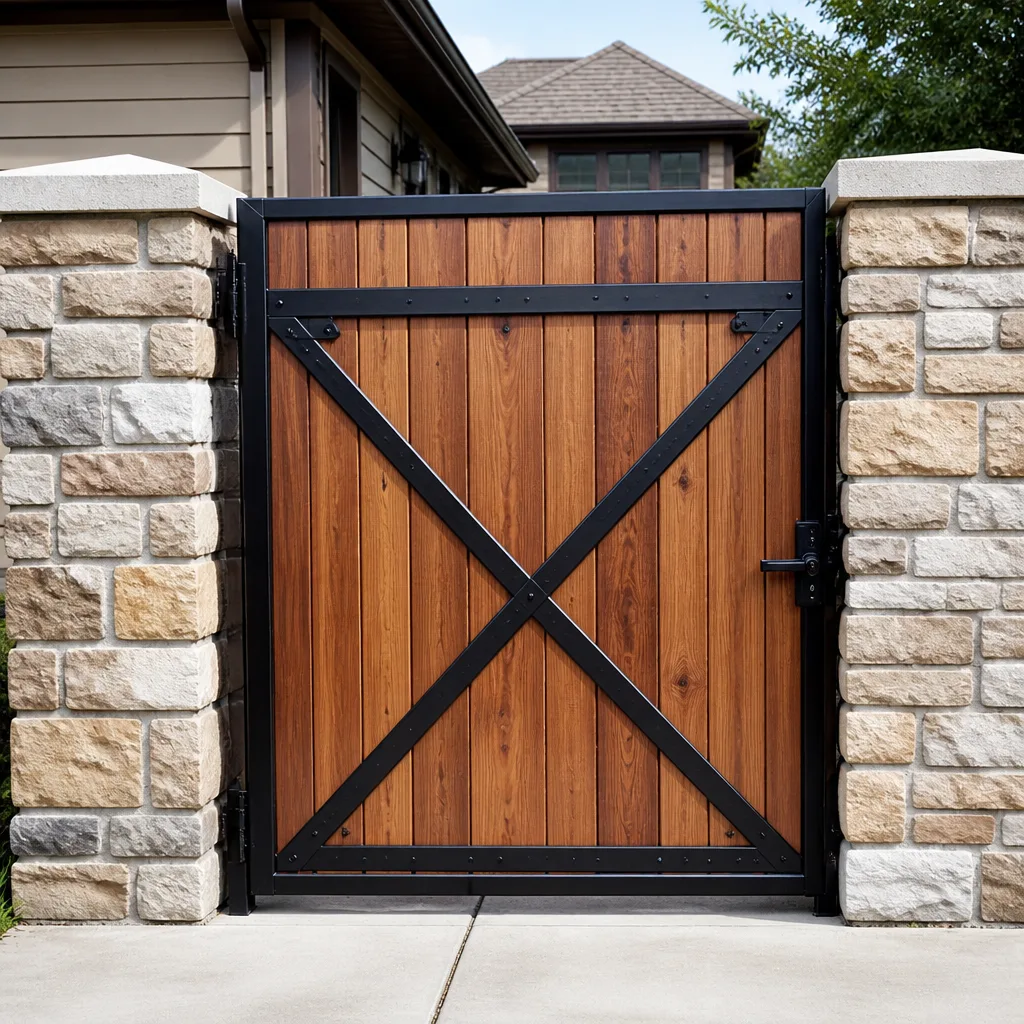 Wood & steel frame
 Farm & ranch
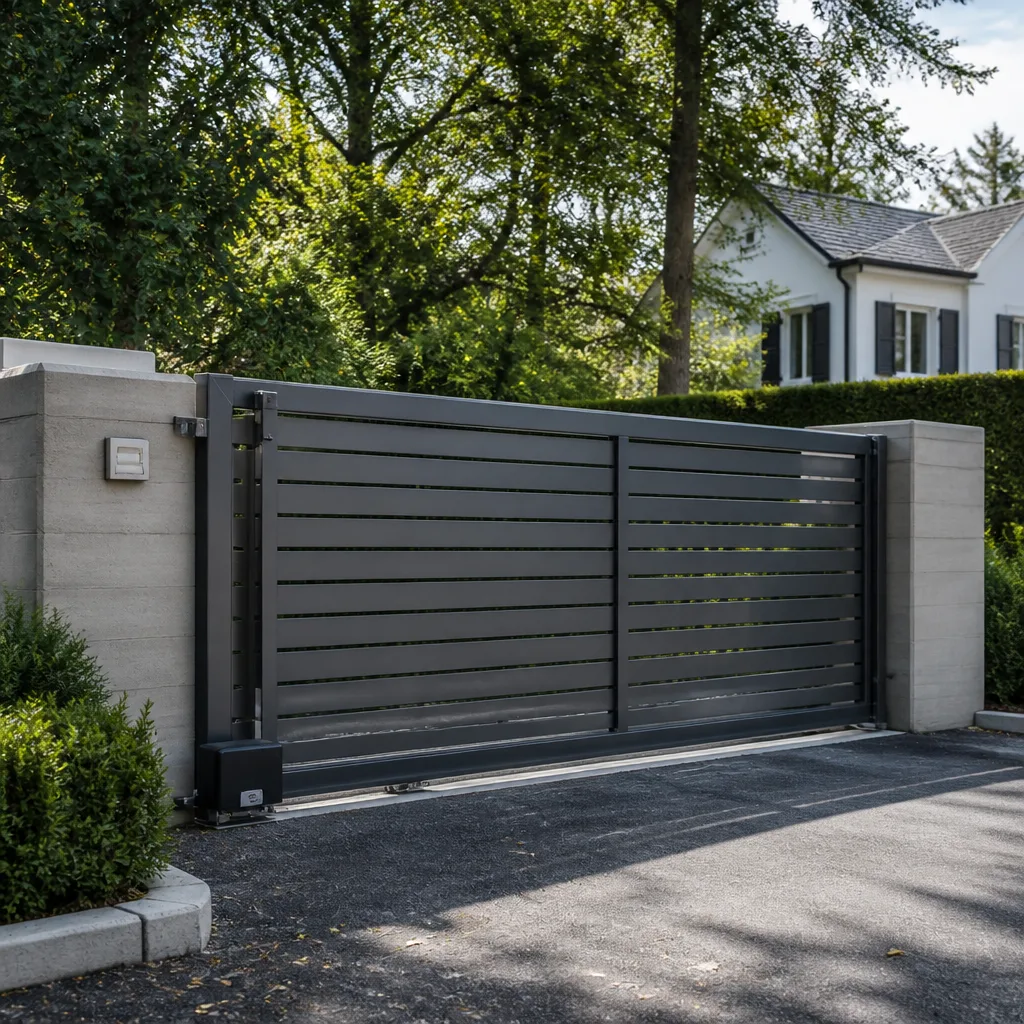 Sliding driveway gates
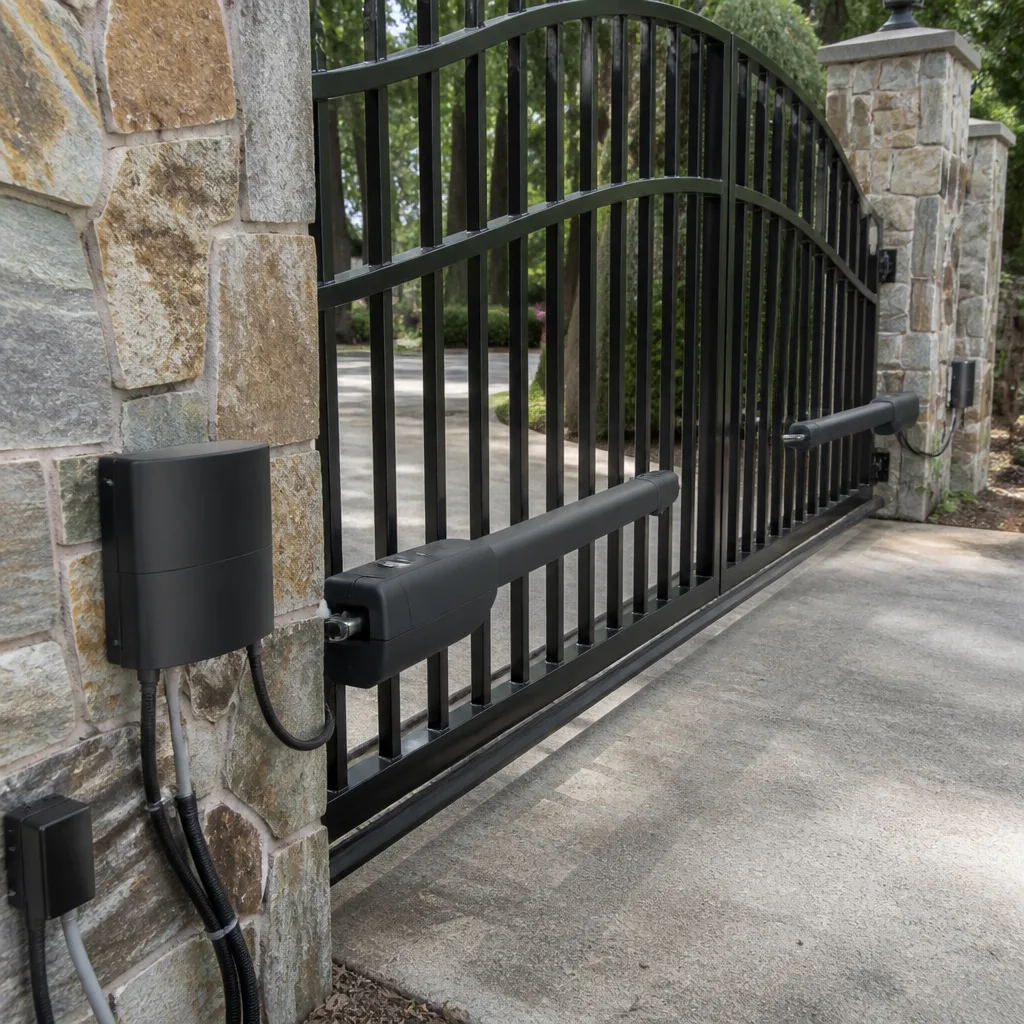 LiftMaster operators
Free on-site gate assessment - hinges, posts, and your LiftMaster or Nice gate operator checked before anything is quoted
The assessment is free and the quote is the invoice.
Get your free estimateDIY vs Professional Gate Motor & Opener: What’s Safe to Do Yourself
Hal will be the first to tell you that pairing a new remote or programming a keypad is not a job you need to pay anyone for. He’ll also tell you that splicing low-voltage control wire into a live 120V operator circuit without pulling the disconnect is how people end up in the emergency room. He has seen both, more than once, in Spring Valley driveways. The DIY line on gate openers is not really about how handy you are. It’s about voltage and liability. This guide draws that line honestly, task by task: what you can safely do this weekend, what will cost you a gearbox if you try, and how to tell a technician what you touched so the diagnostic stays cheap.
Quick Answer
You can safely handle remote pairing, keypad programming, photo-eye realignment, and minor limit adjustments on a gate operator. You should not touch the main 120V power feed, motor capacitor replacement, or loop detector leads buried in asphalt. Anything that brings your hands near line voltage belongs with a licensed technician, full stop.
Styles & brands we work with
- Wrought iron
- Wood & steel frame
- Farm & ranch
- Sliding driveway gates
- LiftMaster operators
Table of Contents
- What you can safely do yourself
- Where the hard stop is
- Nevada electrical code and DIY legality
- The hidden cost of motor mounting errors
- What to tell a tech after a failed DIY attempt
- Brand matters: what we see on Spring Valley gates
- What normal looks like for a Spring Valley gate
- Common mistakes to avoid
What you can safely do yourself
These four tasks account for most of the service calls we get that didn’t actually need a service call. A reasonably handy homeowner can do every one of them with the operator manual and twenty minutes.
1. Remote pairing. Every major brand has a learn button on the receiver or the control board. Press it, press your remote, done. On LiftMaster and Elite operators the button is usually under the light cover. On Mighty Mule it’s often on the control box face. The manual tells you which LED sequence means “paired.” If it doesn’t blink when it should, the remote battery is the first thing to swap, not the receiver.
2. Keypad programming. Same principle. You’re writing a code into the keypad’s memory, then teaching the operator to accept that keypad. Most keypads let you set a temporary code for a contractor or a houseguest and delete it later. That’s a legitimate DIY task, and it’s one of the better security habits to build.
3. Photo-eye realignment. If the gate stops and reverses for no reason, the safety eyes are usually the culprit. Look for a spider web, a leaf, or a sun angle hitting one eye wrong. Clean the lens, check that the two eyes point at each other, and tighten the bracket if it’s loose. That fixes a surprising share of “my gate won’t close” calls.
4. Minor limit adjustments. The limit switches tell the operator where full open and full close are. If the gate is stopping an inch short, the manual usually walks you through the adjustment. Go slow, move in small increments, and test between each one.
None of these require you to open a line-voltage box. That’s the dividing line, and it’s a clean one.
Where the hard stop is
Here’s where we stop encouraging you. Three jobs look like DIY and aren’t.
- The main power feed. The wire running from your panel or a dedicated circuit to the operator is line voltage. It can kill you. It also has to be done to code, and code compliance is on you if you sell the house. This is licensed-electrician territory or, at minimum, a licensed gate tech who is insured for it.
- Loop detector leads in asphalt. The loop is a wire coil cut into the driveway. When it fails, the diagnosis is straightforward but the repair means saw-cutting concrete and re-pouring. Twisting new leads into the old ones without the right splice and seal is how water gets in and the loop fails again by winter.
- Motor capacitor replacement. The capacitor holds a charge even after the power is off. Discharging one the wrong way is a shock hazard, and installing the wrong microfarad value will burn out the motor. On a FAAC or a LiftMaster slide operator, this is a fifteen-minute job for a tech and a bad idea for a homeowner.
There’s a fourth category that isn’t dangerous but is usually a waste of money: swapping control boards by guesswork. Boards are expensive, and the actual fault is often upstream. If the gate does nothing, the fault could be the board, the power, the safety circuit, or a limit switch. Throwing a board at it is a coin flip with your wallet.
Nevada electrical code and DIY legality
This is the part most guides skip, and it’s the part that actually determines whether your DIY repair is legal.
Nevada follows the National Electrical Code, and the NEC draws a firm line between Class 2 low-voltage control wiring and line-voltage branch circuits. Low-voltage work – keypad wiring, photo-eye wiring, remote receivers, loop leads – is generally something a homeowner can legally do on their own property. It’s also the wiring most homeowners actually touch.
Line-voltage work is different. Running a new circuit to an operator, adding a disconnect, or replacing the feed requires a permit in most Nevada jurisdictions and, in practice, a licensed electrician. That’s not a technicality. The disconnect requirement exists so a tech can kill power at the gate and not at the panel fifty feet away. A previous owner who skipped it because it was easier is a technician standing at your gate with his heart in his throat. We’ve found more than one Spring Valley gate running on a disconnect that was never installed.
Gates are also a safety device. If a gate operator was installed or modified without meeting the current safety standard, and someone is injured, the liability question is going to be ugly. That’s the real reason to have the line-voltage side done right and documented. If you want a plain-language second opinion on what’s compliant, our gate motor and opener service covers that.
The hidden cost of motor mounting errors
This is the single most expensive DIY mistake we see, and it doesn’t show up for months.
A slide gate operator drives a pinion gear along a rack bolted to the gate. That mesh has to be right. If the operator is mounted even two degrees out of parallel with the rack – or if the rack is bowed, or the pad settled – the pinion and rack mesh at an angle instead of face to face. The gate still opens. It sounds fine for a few weeks. Then the drive gear starts to wear in a pattern that gets worse on its own. In our experience, a two-degree misalignment is enough to destroy the drive gear within a year. A new gearbox is a several-hundred-dollar part, and it’s not covered by the warranty because the warranty covers the part, not the mounting error that killed it.
The swing gate version is subtler. Swing operators are sensitive to the gate’s own geometry. If the hinge post is off, the gate sags, and the operator fights that sag on every cycle. We’ve seen operators replaced three times in a year because nobody looked at the post. A gate sags in the hinge post, not in the middle, and that is where we start. This is exactly why we do gate repair with the gate still bolted in place rather than swapping parts and hoping.
What to check before you drill a single hole in a new mount:
- Confirm the pad is level and hasn’t settled. A two-year-old pour is not the same as a fresh one.
- Run a string line along the rack and check the gap end to end. It should be even, not tighter at one end.
- Check the hinge post for movement before you mount the operator. If the post moves, the operator will too.
- Manual the gate fully open and closed. It should move with one hand. If it drags, fix that first.
What to tell a tech after a failed DIY attempt
Be honest. That’s the whole advice, and it will save you money.
When you tell a technician “I tried a few things,” the diagnostic clock starts at zero. When you tell them “I swapped the receiver, then I reprogrammed the keypad, then I moved the limit switch about a quarter inch, and after that the gate started reversing every other cycle,” the diagnosis is nearly free. We can rule out three things immediately and go straight to the fourth. That’s the difference between a thirty-minute visit and a two-hour one.
A short, honest list of what matters:
- What you touched, in order, and what changed after each step.
- Any part you replaced or moved, even if you put it back.
- Whether you cycled the breaker, and whether you still have power at the operator.
- Any new sound, smell, or behavior – a click, a hum, a reversal.
We’re not going to lecture you about it. The homeowner who tried is the homeowner who cares about their gate. But covering it up makes our job harder and your invoice bigger. Nobody wins that trade. If you want to compare what you were told by a previous company, we offer a free second opinion on any written estimate.
Brand matters: what we see on Spring Valley gates
Different operators have different DIY boundaries. On a LiftMaster swing operator, the control board is buried behind a cover with live terminals you shouldn’t reach into. Remote pairing and keypad work are fine. On a Mighty Mule or Elite slide operator, the control box is easier to reach, which makes DIY more tempting and slightly more dangerous. On a FAAC hydraulic operator, the fluid system is not a homeowner task at all – and we’ve seen a homeowner try.
All three brands show up on the gates we work on in Spring Valley, and each has its quirks. A keypad that programs in one minute on a LiftMaster may need a different sequence on an Elite. The manual is not optional reading. It’s the whole job. We’re certified to service nine major brands and we’ve seen every one of them done wrong at least once. If you’re not sure what you’re looking at on the control board, give us a call and describe it – that’s a free conversation.
What normal looks like for a Spring Valley gate
Spring Valley sits on the edge of the Mojave, and that changes the failure pattern. Gates here cycle through 100+ degree summers and hard cold snaps in winter. Metal expands and contracts by enough that a perfectly adjusted limit on a July afternoon stops dead in January. Photo-eyes get coated in wind-blown dust and need cleaning more often than the manual says. And the summer sun on a black operator housing is a real heat load – we’ve seen control boards cook that were rated for it.
That’s not a reason to call a tech every spring. It’s a reason to spend ten minutes checking the eyes and the limit stops when the seasons change. It’s also a reason to be skeptical of any installation done on a hot afternoon and never re-checked. Gates that work fine in fall are the ones that fail in the first hard freeze.
Common Mistakes to Avoid
- Working near the operator without pulling the disconnect. Even low-voltage work is safer with the power off. That’s the one habit that prevents most gate-related injuries.
- Mounting a new operator on a gate that drags. If the gate is stiff on its own, the operator is going to fight it every cycle, and the gear wears accordingly. Fix the gate before the machine.
- Replacing a control board without checking the power. More than once, we’ve found the actual problem was a dead circuit or a tripped breaker – and the homeowner had already bought a new board.
- Ignoring the hinge post. It’s the cause of most sag, and it’s the thing homeowners look past because the problem appears at the latch.
- Using the wrong capacitor value. A capacitor is not a capacitor. Matching the microfarad rating on the old one matters, and putting it in wrong can burn out the motor.
- Splicing loop leads with wire nuts. Wire nuts in asphalt fail within a year. The loop needs a proper splice and seal, or you’ll be saw-cutting the driveway again.
- Skipping the disconnect when you install a new operator. The disconnect exists so the next tech can work safely. A gate installed without one is a liability that follows you when you sell.
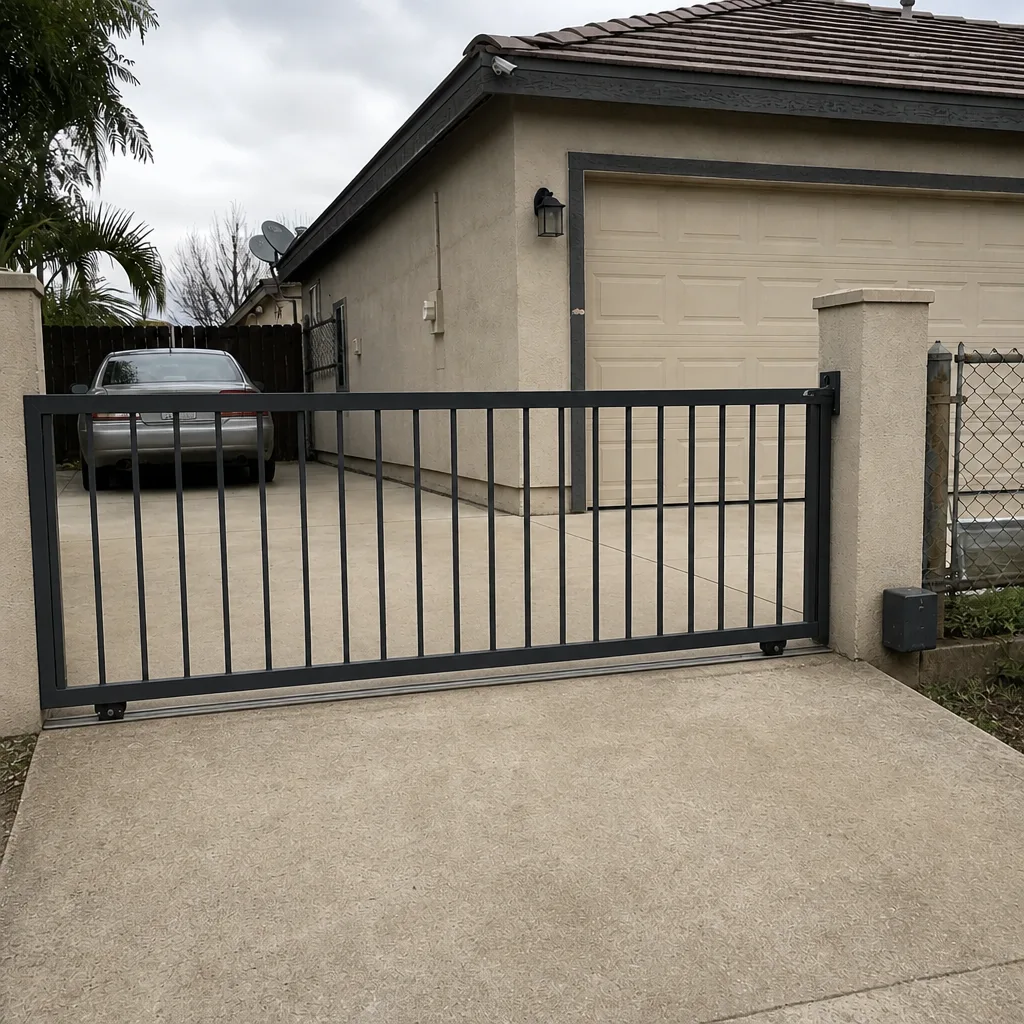
See the difference
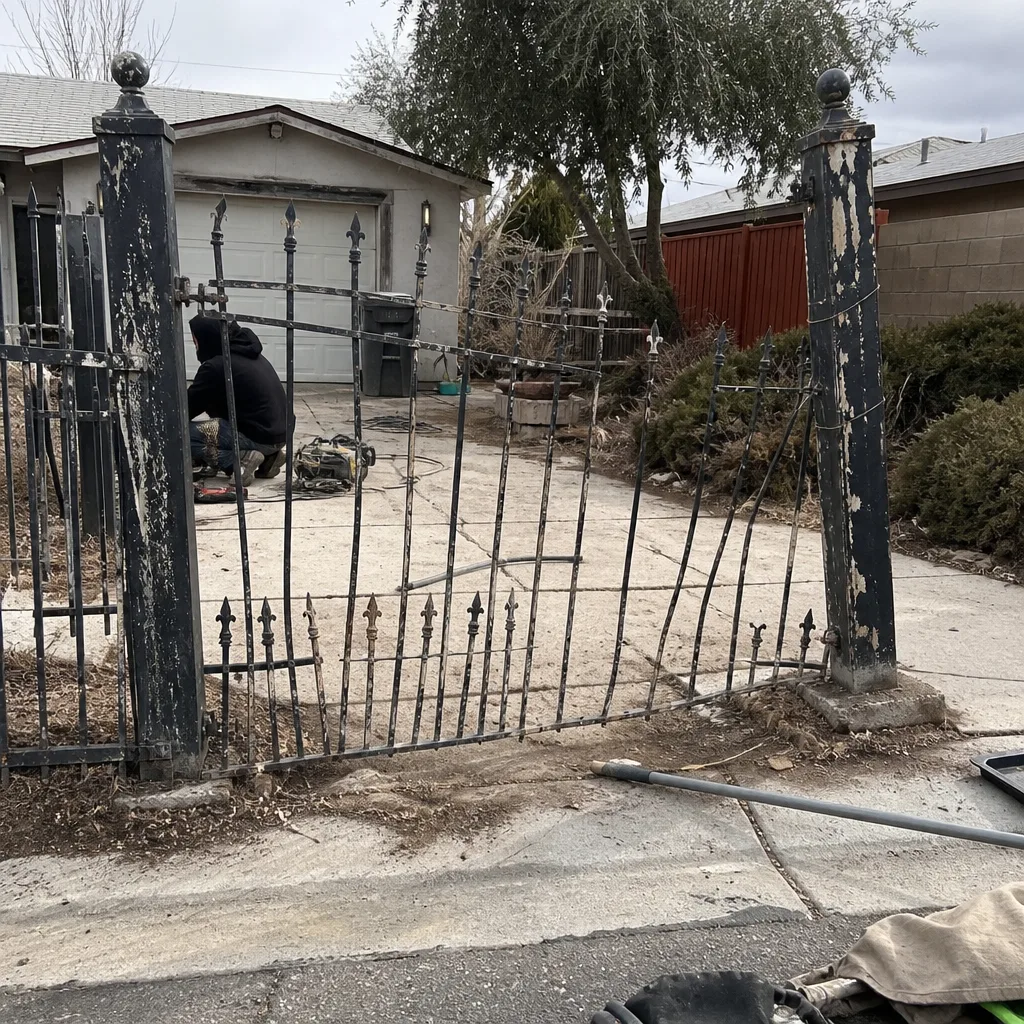 Before
 After
 Before
 After
 Before
 After
When to Call a Professional
Call us when the problem is line voltage, a motor capacitor, a loop detector in asphalt, a control board, or a mounting diagnosis. Call when the gate reverses on its own after you’ve cleaned the eyes and checked the bracket. Call when you’ve already tried something and it got worse – that one’s not a failure, it’s an honest starting point. Call when you’re buying a new operator and want it mounted once, correctly, so the drive gear survives. And call when a gate that’s supposed to be a safety device might not be, because that’s not a job for a homeowner with a manual. Gatewood Fence & Gate Spring Valley offers free estimates in Spring Valley – call (888) 300-3906.
Frequently Asked Questions
You can legally do the low-voltage side of the installation yourself, but the line-voltage connection to the operator has to meet NEC and local code, which in most Nevada jurisdictions means a permit and a licensed electrician. The mounting itself is where most DIY installations fail – a slip in the alignment of the operator to the rack will kill the drive gear within a year. A licensed tech doing the whole job correctly the first time is often cheaper than the repair that follows a DIY mount. Call (888) 300-3906 for a free estimate.
Typical repair pricing in Spring Valley runs a few hundred dollars for small parts and labor, and climbs from there for a gearbox or control board. We quote the price up front and agree it with you before any work starts, so the invoice matches the quote. If another company has given you a written estimate, we’ll give you a free second opinion on it. Call (888) 300-3906 for an exact quote.
Often, yes. A gate stuck open is a security concern, and we treat it that way. A live person answers our phone around the clock, not voicemail and not a call center. Call (888) 300-3906 and we’ll tell you straight whether we can get there today.
A full installation includes mounting the operator, aligning it to the rack or arm, wiring the low-voltage controls, installing and testing the safety edges and photo-eyes, installing the disconnect, and running a full open-close cycle test. The price is quoted and agreed before work starts. We schedule installations because they’re measured and parts are ordered – this isn’t a same-day dispatch job. Call (888) 300-3906 for a free measure and a written price.
Yes. Both are part of the installation, and both are the parts we insist on doing ourselves. The power run has to meet code, and the safety edges are what keep a gate from hurting someone. We won’t leave an installation where either is compromised. Call (888) 300-3906 for a free estimate.
Yes, and it’s not a problem. Tell us exactly what you touched and what changed after each step. That honesty cuts the diagnostic time way down, and that saves you money. A technician who knows what’s been tried doesn’t have to re-try it. Call (888) 300-3906.
The Bottom Line
The DIY line on gate openers is at voltage and liability, not skill. Remote pairing, keypad programming, photo-eye cleaning, and minor limit adjustments are yours to do – do them, and keep your gate healthy. Line-voltage work, motor capacitors, loop detectors in asphalt, and any mounting diagnosis belong with a licensed tech. The hidden cost of a DIY mount is a gearbox, and it shows up months after the gate seemed fine. If you’ve already tried something and it didn’t work, tell us honestly and we’ll make the diagnostic easy. The 90-Day Done Right Promise is stamped in writing on every job, so if we get it wrong, one call brings us back. The name is on the shop, and the shop is down the road.
Ready to fix it once, right? Call Gatewood Fence & Gate Spring Valley at (888) 300-3906 for a free estimate. We’re locally owned and owner-operated, proudly serving local communities, with a live person answering the phone 24/7. We’re certified to service nine major gate brands, and we offer a free second opinion on any written estimate. Seniors and veterans get a permanent 10% discount, and there’s no trip charge inside the county. If you’d rather compare us first, read about gate installation in Spring Valley or start at our Gatewood Fence & Gate Spring Valley home page. We’ll be glad to talk.
Written by the team at Gatewood Fence & Gate Spring Valley.