
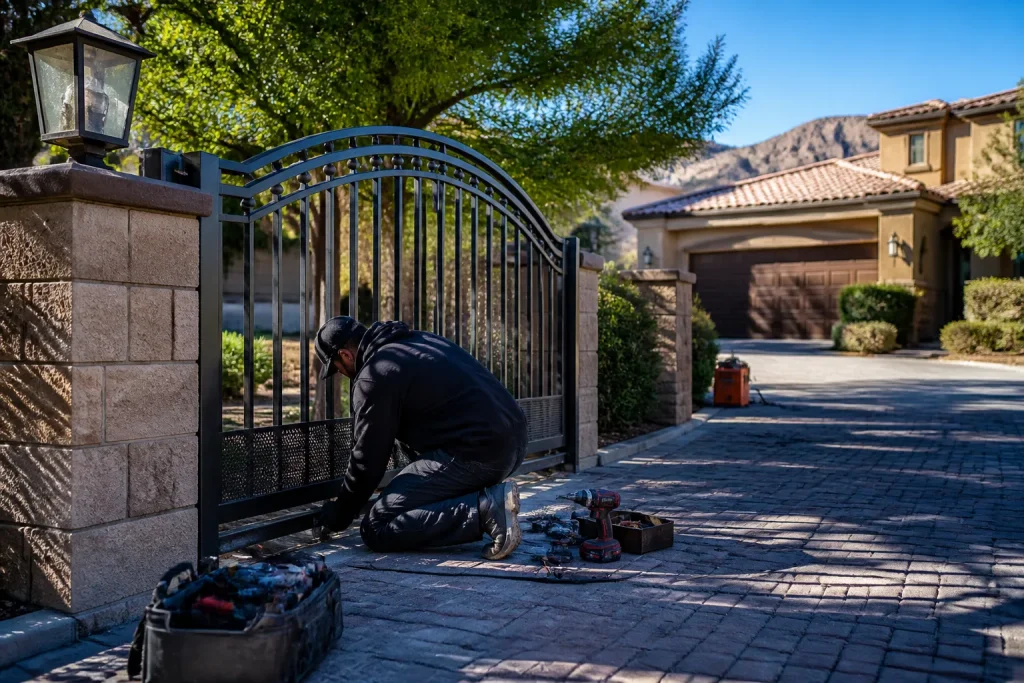
Viking Gate Repair in Spring Valley: A Homeowner’s Guide
Viking operators show up on our repair list more often than their build quality deserves, and the reason is almost always the last service call, not the gate. A technician resets the limits, packs up, and never checks the obstruction force. Now the gate thinks your car is a threat every time it closes. Viking equipment is overbuilt on purpose. Most failures in Spring Valley come down to a skipped adjustment, and once you know which few things Viking is finicky about, you stop chasing the same breakdown in circles.
If you’d rather skip the troubleshooting and get a straight answer, call (888) 300-3906.
Why Viking Gates Fail in Spring Valley (and Why It’s Usually Not the Gate)
A Viking gate that stops, reverses, or refuses to close is usually telling you something specific. The trick is listening to it in the right order. In our experience, the three most common culprits in Spring Valley are miswired loop detectors, skipped force calibration, and a rack gear that’s been grinding quietly for a season.
Here’s the order we check things in:
- Loop detector wiring. First, last, and always. More on this below.
- Obstruction force setting. Was it recalibrated after the last limit adjustment?
- Rack and hinge condition. Physical wear masquerading as an electrical problem.
- Motor capacitor. Only after the first three are cleared.
We pulled a Viking operator apart over in Rhodes Ranch last month where the homeowner had already replaced the control board twice. The board was fine both times. The reverse loop was wired to the wrong terminal, and every closure triggered a phantom stop. Two hours of wire tracing beat a second board.
Start Here: Viking’s Dual-Loop Detector Wiring
Before you touch anything else on a Viking system, inspect the loop detector wiring. Viking operators typically use two loops (an exit loop and a safety/reverse loop), and a miswired or swapped connection causes ghost-stop behavior that looks exactly like a failing control board. Homeowners get talked into a new board, the gate still acts up, and the real problem is two wires crossed at a terminal strip.
What to look for:
- Labels matching terminals. Exit loop into the exit terminals, reverse loop into reverse. Sounds obvious. It gets missed constantly.
- Loose or corroded screws. Spring Valley’s summer heat bakes connectors. Loose terminals create intermittent faults.
- Water in the loop saw-cut. Monsoon runoff finds low spots. A wet loop reads false presence.
- Splices in the driveway. Any splice not in a proper junction box is a future ghost stop.
If your gate stops for no visible reason and then works fine an hour later, this is the first place to look. It’s also the cheapest repair in this entire guide, which is why it’s worth ruling out before anyone quotes you a control board.
Obstruction Force Calibration: The Step Everyone Skips
This is the one that turns a limit adjustment into a repeat service call. After any limit change on a Viking operator, the obstruction force has to be recalibrated. The manual spells out the sequence. Skip it and one of two things happens:
- The gate reverses on nothing. The operator reads normal resistance (a stiff hinge, a hot day, a little wind) as an obstruction.
- The gate doesn’t reverse when it should. Worse. That’s a safety failure, and it’s the one that matters most.
You can test the second one yourself without tools. Stand clear, put a light object in the gate’s path (a rolled-up towel works), and trigger a close. The gate should reverse on contact. If it keeps pushing, stop using the operator and get it looked at. That’s not a nuisance, it’s a liability.
If you’re not comfortable running the calibration sequence, this is a good place to bring in help. Our Gate Repair in Spring Valley page covers what a full adjustment visit includes.
Spring Valley Heat and Viking’s Hydraulic Operators
Spring Valley runs hot in summer and swings hard between day and night. That matters more for Viking’s hydraulic operators than for chain-drive units, and it shows up as slow-open complaints every July and August.
Hydraulic fluid viscosity changes with temperature. When it thins out in the afternoon heat, the operator works harder to move the same gate, and the symptom is a gate that crawls open at 2 p.m. and runs fine at 7 a.m. Chain-drive models don’t behave this way, which is why a homeowner who’s owned both gets confused when the new gate acts sluggish.
The seasonal check that heads this off:
- Fluid level and condition on the hydraulic reservoir, inspected before the summer push.
- Manual release test so you know the gate moves freely by hand. If it doesn’t, the operator is fighting the gate, not the heat.
- Hinge lubrication in late spring. Dry hinges add resistance the hydraulic unit reads as load.
Do this in May and you skip most of the slow-open calls we get in June. If the gate is already sluggish, our Gate Motor & Opener in Spring Valley page walks through what a proper service visit looks like.
Rack Gear or Capacitor? How to Tell Before You Call
You can often diagnose this one from the driveway. Two failures that sound similar have very different repair bills, and knowing which you have saves you a diagnostic fee and a bad surprise.
Worn Rack Gear
A worn Viking rack gear makes a rhythmic grinding or clunking sound, timed to the gate’s travel. The noise repeats. It gets worse near a specific spot on the track. It’s mechanical, so it follows the gate’s movement, not the motor’s spin.
Failing Capacitor
A failing motor capacitor causes the motor to hum and stall, struggle to start, or need a nudge. The noise is electrical, not rhythmic. It’s tied to whether the motor spins up, not to where the gate is on its track. The gate may also run fine in one direction and stall in the other.
Quick test: stand at the gate and listen. Rhythmic grind that follows the gate equals rack. Hum and stall at startup equals capacitor. That distinction alone tells you whether you’re looking at a mechanical repair or a small electrical part, and it keeps anyone from quoting you a motor replacement for a $30 capacitor problem.
Safety Labels, Inspection, and Your Insurance
Viking operators ship with safety entrapment labels in specific positions. The placement isn’t decorative. It’s an inspection requirement, and a gate that fails inspection on label placement can complicate your homeowner’s insurance on a related claim. That’s a real consequence, not a technicality.
What inspectors look for on a Viking gate:
- Entrapment warning labels in the positions the manual specifies, legible and not sun-faded.
- Photo-eye or loop protection that actually reverses the gate on obstruction.
- Manual release working and reachable.
- Label condition. A label baked off by five Spring Valley summers isn’t compliance.
If your labels are peeling or gone, replace them before an inspector finds them missing. It’s a five-minute job and it closes a real gap between your gate and your policy.
When to Call a Pro
Most of the checks in this guide are safe to do with your eyes and ears. The moment you’re adjusting force settings, tracing loop wiring, or working near a moving gate with a heavy panel, stop and call. A gate that fails to reverse on obstruction is a serious safety problem, and Viking hydraulic units store pressure that can hurt you.
Viking isn’t the only operator we see with these issues. Ghost Controls and DoorKing units show similar symptoms when the force calibration gets skipped, and Elite operators have their own quirks. Our Gate Installation in Spring Valley page covers what a properly commissioned setup looks like from day one.
Related services in Spring Valley: gate repair, gate installation, gate motor and opener service. Start at our Gatewood Fence & Gate Spring Valley home page if you’re not sure which applies.
The Bottom Line
Viking gates are built to last. When one fails, the fault is usually a skipped step from the last service call: miswired loops, uncalibrated force settings, or a label and adjustment issue nobody caught. Check in this order: loops, force, rack, capacitor. You’ll save yourself a diagnostic fee and a wrong repair.
If you’re in Spring Valley and need help, Gatewood Fence & Gate Spring Valley offers free estimates. Every job carries our 90-Day Done Right Promise in writing, we weld on site so the gate stays in your driveway, and a live person answers the phone around the clock. Call (888) 300-3906.
Frequently Asked Questions
A gate that reverses on nothing usually has an obstruction force setting that’s too sensitive, often because the last technician reset the limits without recalibrating the force. Miswired reverse loop detectors cause the same ghost-stop behavior. Check the loop wiring first, then the force setting. Call (888) 300-3906 for a free second opinion on any written estimate.
Listen for the timing of the noise. A rhythmic grind that follows the gate’s travel points to a worn rack gear. A hum and stall at motor startup points to a failing capacitor. The two repairs have very different costs, so diagnosing correctly before you call saves money. Our technicians have up to 25 years of experience with both. Call (888) 300-3906 for an exact quote.
Some slowdown in Spring Valley heat is normal for hydraulic operators because fluid viscosity changes with temperature. A gate that crawls badly at 2 p.m. needs a fluid and hinge check before the summer push. Lubricate hinges in late spring, verify the fluid level, and test the manual release. If it’s still sluggish, call (888) 300-3906.
They can. Viking’s entrapment warning labels have specific placement requirements, and a gate that fails inspection because they’re missing or faded can complicate an insurance claim tied to the gate. Replace peeling labels before an inspection. If you’re not sure whether your setup passes, call (888) 300-3906 for a free estimate.
Written by the team at Gatewood Fence & Gate Spring Valley.
Need Gate Repair Help?
Call Gatewood Fence & Gate Spring Valley - licensed & insured, here with fast after-hours help in Spring Valley.
(888) 300-3906