
Gate Installation: Repair or Replace? How Spring Valley Homeowners Decide
Most “unrepairable” verdicts aren’t about the gate. They’re about who’s doing the looking. A gate that gets tagged for replacement by one outfit is often welded back to full swing the same afternoon by someone who actually inspects the hinge post instead of the sales sheet. Here in Spring Valley, the difference between a $280 repair and a $3,800 installation usually comes down to one question: is the person in front of you equipped to fix things, or only to sell new ones? This guide gives you a framework to make that call yourself, based on what’s actually failing.
Why “Just Replace It” Usually Comes From the Company, Not the Gate
Installations pay better than repairs. That’s not a scandal, it’s just arithmetic. A welded hinge post repair might bill an hour of labor and a handful of parts. A full install bills the gate, the posts, the concrete, the operator and a day of work. When a company only sells installations, every problem looks like an installation. When a company makes its money on repairs, the math flips.
In our experience across Spring Valley, the recommendation to replace usually walks in before anyone has put a wrench on the gate. You’ll hear phrases like “these aren’t built to be fixed anymore” or “you’ll be back out here in a month.” What’s often missing is any mention of what specifically failed and whether that specific part can be repaired or matched. A sagging gate with a rusted hinge is a hinge problem. A sagging gate with a cracked weld collar at the post is a frame problem. A sagging gate with a tilted post is a foundation problem. Those are three different conversations, and only one of them is really about replacement.
If you’d rather not guess whether you’re being sold, ask for the failing component in writing. A real diagnosis names the part. A sales pitch doesn’t.
The Hinge Post Test: What We Check Before Recommending Anything
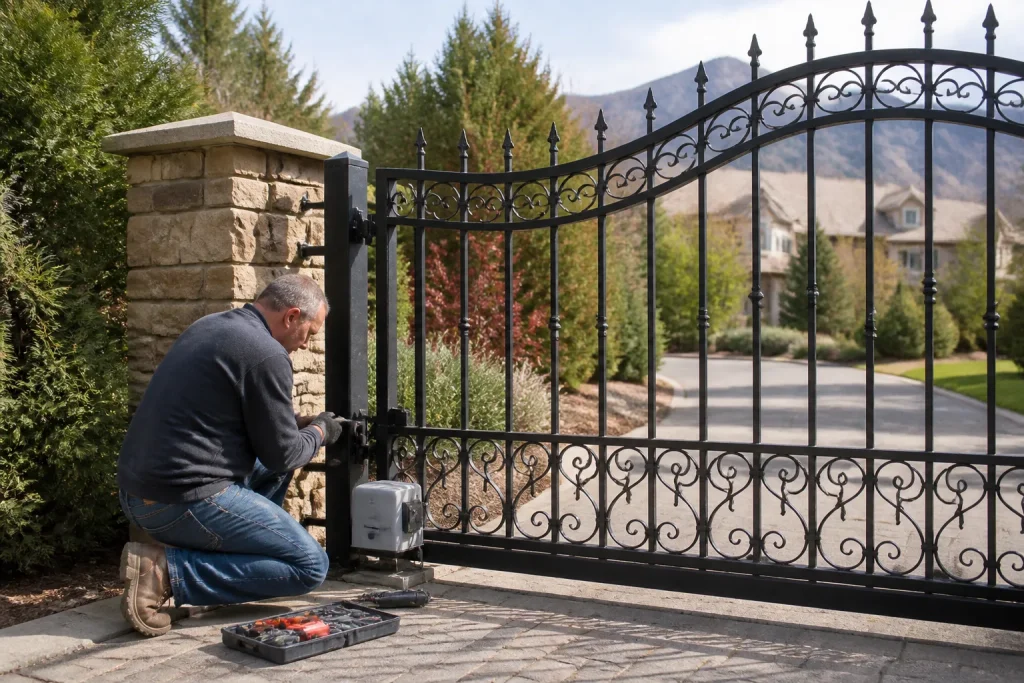
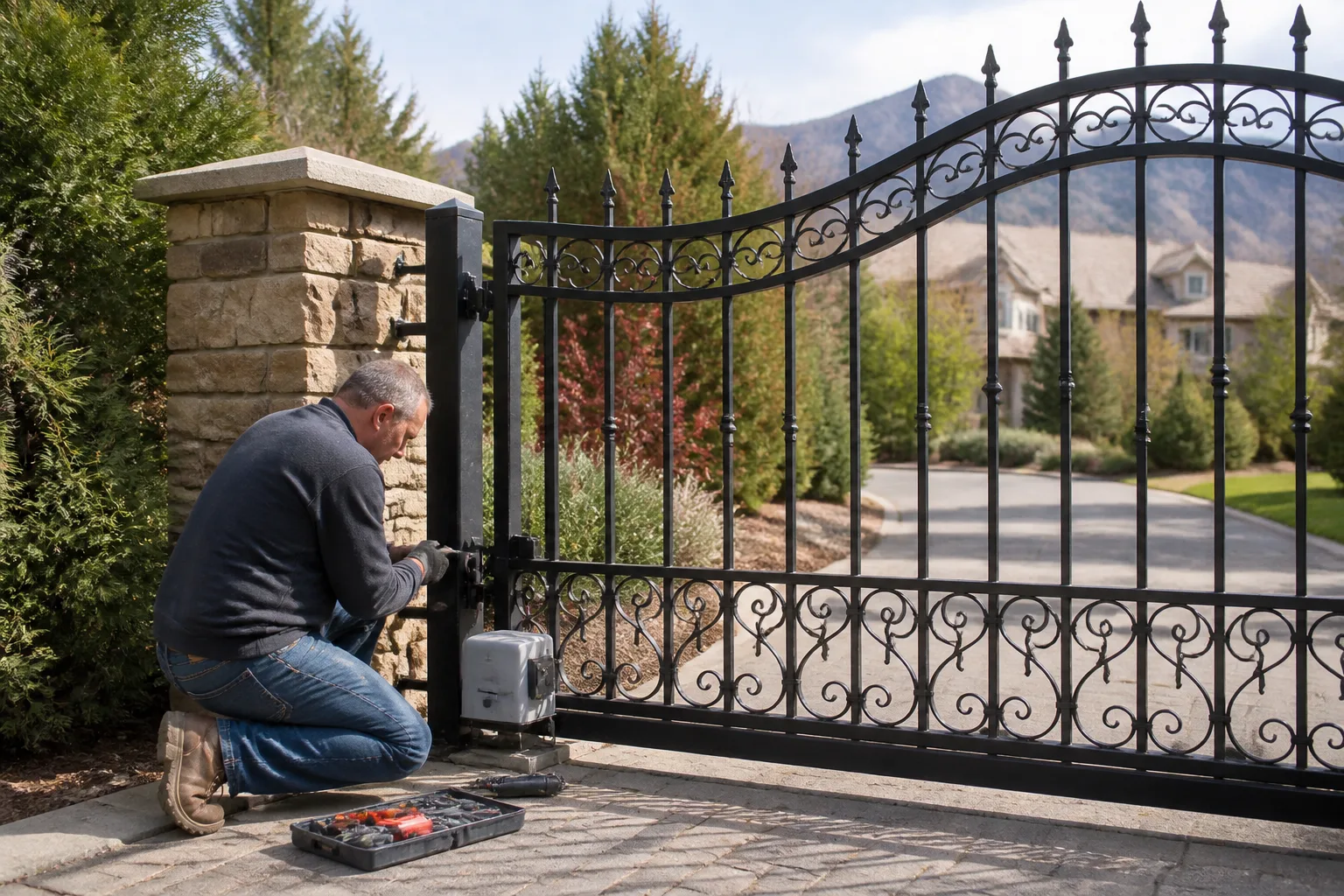
A gate sags in the hinge post, not in the middle. That’s where we start every inspection in Spring Valley, and it’s the fastest way to separate a one-hour repair from a real structural conversation.
Here’s how the test runs on site:
- Watch the gate swing free of the operator. Disconnect the motor or unlatch it. If the gate drags, sticks, or won’t sit level on its own, the failure is mechanical, not electronic.
- Grab the gate at the latch edge and rock it. Any sideways movement at the hinge point means the hardware or the welds are loose. Movement at the ground means the post is moving.
- Check the hinge plates. Rusted pins, worn bushings, or wallowed-out bolt holes are a hinge repair – usually an hour or two with on-site welding and new hardware.
- Inspect the post itself. Is the concrete collar cracked? Is the post leaning? Has the soil heaved around it after a wet winter? That’s the ground-up test, and it changes the plan.
- Look for frame cracking at the weld collar. A hairline split at the joint where the rail meets the post collar is a structural repair, not a hardware swap.
A gate that fails steps 1 and 2 but passes steps 4 and 5 is almost always repairable. A gate that fails step 4 is where we stop and start talking honestly about scope. You can read more about how we approach that inspection on our Gate Repair in Spring Valley page.
Crunching the Real Break-Even Number
The math a salesperson gives you compares today’s repair quote to today’s replacement quote. That comparison is useless. The right comparison is repair cost against the remaining mechanical lifespan of the gate.
Here’s the framework we use. Start with how many more years of service the gate has if it’s repaired properly. A well-built steel or aluminum swing gate with a sound frame commonly has 10 to 15 years left when the only failure is hardware, a hinge, or a weld. Now price the repair. Divide the repair by those years. That’s your cost-per-service-year. Do the same math on the replacement.
An example: a $340 hinge and weld repair on a gate with 10 good years left is $34 per year. A $3,800 replacement covers 15 to 20 years, so that’s $190 to $253 per year. Repair wins on this math every time – unless the gate’s underlying lifespan is nearly used up.
That’s the flip side. If the frame is fatigued, the post concrete is failing, or the manufacturer’s parts have been discontinued, the gate’s remaining years shrink fast. Then repair math stops working. That’s not a sales line, either. That’s just arithmetic catching up.
- Repair math wins when the failure is contained to hinges, hardware, a weld, or an operator component.
- Replace math wins when the frame or foundation is compromised, or when the parts don’t exist anymore.
- It’s a wash when the gate is 15+ years old with signs of fatigue in multiple places. Then the decision is about your tolerance for a second repair, not the money.
The Three Times Replacement Genuinely Makes Sense
We’re not anti-replacement. Fair is fair, and there are three conditions in Spring Valley where a new gate is the honest answer.
1. Frame cracking at the weld collar. When the tubular frame splits at the joint where the rail meets the hinge-side collar, welding the crack is a bandage. The metallurgy is telling you the frame is fatigued. On a light-gauge gate, especially one that’s been rocking on a bad hinge for years, the crack comes back. Replace it.
2. Post concrete heave beyond a certain degree. A leaning post can sometimes be corrected with a new footing and re-set. But when the concrete collar is heaving more than a few degrees out of plumb, or the post has visibly pulled away from the ground line, we’re now rebuilding the whole gate anchor point. At that scope, a fresh installation often makes more sense than a repair that leaves you with a partially compromised post.
3. Discontinued parts with no compatible substitute. This is the one most homeowners haven’t heard of. Access control boards, receivers, and specific operator components get discontinued. When you’re running a DoorKing or Linear system that’s been out of production long enough, we sometimes can’t source a compatible replacement. Then a full installation is genuinely the right call. Before you accept that verdict, though, ask whether the company has actually checked the brand’s current replacement catalog. We carry certified service on nine major brands – LiftMaster, FAAC, BFT, Linear, Viking, Ghost Controls, DoorKing, Elite, and Mighty Mule – specifically so we can find the substitute that fits.
The Operator Trap: Replacing Years of Life Left
A gate operator that won’t respond doesn’t mean the operator is dead. In Spring Valley, we see this every season. A homeowner is told the whole system needs to be replaced. What actually failed was the keypad, the receiver, or a $60 control board component. Those are three of the most common component failures on any swing or slide operator, and any of them can make a perfectly healthy motor seem dead.
Before you replace an operator, get these checked:
- The keypad or entry panel – the number one false-alarm component.
- The receiver and remote pairing – a quick reset resolves most “dead remote” calls.
- The control board – individual components fail, boards rarely fail whole.
- The battery backup – a weak battery will stop the gate and look like a motor failure.
- The safety edges – a damaged edge or miswired photo-eye stops the operator as a safety feature. That’s a component, not a motor.
We pull operator motors out of garages here in Spring Valley that have years of life left in them, all because a keypad failed over a holiday weekend and the homeowner was told the whole system was done. If you’re at that decision point, our Gate Motor & Opener in Spring Valley page walks through what a proper operator diagnosis looks like.
Questions to Ask Before You Accept “Replace It”
Nobody has to take our word for any of this. Ask the next company that recommends a full replacement these questions. If the answers are vague, you’ve learned something useful.
- What specifically failed? Get the component named in writing – the hinge, the weld, the post, the board, the receiver.
- Do you have on-site welding capability? If the answer is no, the gate has to be hauled off or the repair becomes a swap. True repair-first work happens in your driveway.
- Have you priced the actual repair? Not “the repair won’t help you.” A number. On paper.
- What’s the remaining mechanical lifespan if you repair it? If the answer is “not long” but there’s no reasoning, ask again.
- Is the replacement part compatible with the existing gate or system? A sales pitch ignores compatibility. A diagnosis uses it.
- Is there an operator component or accessory swap that solves this? Keypads, receivers and safety edges all have serviceable replacements.
We’ll also add this: get a second opinion when a replacement verdict comes with pressure. We’ll give you one on any written estimate, no charge. That offer exists because we’ve seen enough bad verdicts to know it matters.
When to Call a Pro
Here’s where we put our own limits on the conversation. High-tension springs, torsion assemblies, and the anchor points that hold a heavy gate frame are genuinely dangerous to work on. A gate that fails under a bad weld or a failed retention point can drop. We don’t give out step-by-step instructions for that work, and nobody else should either. If you’re not sure whether the failure is in the weld, the hinge, or the post, that’s exactly when to call. The structural questions deserve eyes on the gate.
If you’re in Spring Valley and want a real diagnosis – not a pitch – we can take a look. Our team has technicians with up to 25 years of experience, and we’ll tell you plainly whether the honest answer is fix it, wait, or replace it. Call us at (888) 300-3906 for a free estimate.
Related services in Spring Valley: for the full picture, see our Gate Installation in Spring Valley page, or start from the Gatewood Fence & Gate Spring Valley home page.
Key takeaways: A hinge failure is usually a one-hour weld-and-hardware repair. A post or foundation failure is a real conversation. The break-even math favors repair unless the frame, the post, or the parts are genuinely at the end of the line. And a failed keypad, receiver, or safety edge is not a failed operator. Name the component before you accept a replacement.
The Bottom Line
Almost every gate we diagnose in Spring Valley falls into one of three buckets: a contained component failure that’s a clean repair, a structural failure that makes replacement the honest call, or a borderline case where the numbers are a wash and the answer comes down to how long the frame will genuinely hold. The one thing that’s almost never true is a sweeping “these aren’t built to be fixed” verdict brought to you by a company that sells installations exclusively.
If you’re near Spring Valley and need help, Gatewood Fence & Gate Spring Valley offers free estimates – call (888) 300-3906. We weld on site, so the gate stays in your driveway. We carry a written 90-Day Done Right Promise on every job. And if the answer really is “replace it,” we’ll show you the failing part and the math behind that call. You can drive over and look us in the eye if you’d rather.
Frequently Asked Questions
Rock the gate at the latch edge with the operator disconnected. Sideways movement at the hinge point means the hinge or hardware is loose, which is usually a repairable hinge problem. Movement or tilt at the ground line means the post or concrete footing is failing, which is a bigger structural conversation. In Spring Valley, most sagging gates we see are hinge failures, not foundation failures.
Repair is almost always cheaper in the short term, and often in the long term too. Divide the repair cost by the remaining years of mechanical life on the gate, and do the same for replacement. A $340 weld-and-hinge repair on a gate with ten good years left is $34 per year. A $3,800 installation covering 15 to 20 years works out to $190 to $253 per year. For an exact quote on your gate, call (888) 300-3906 – estimates are free.
Probably not. The most common failures we diagnose in Spring Valley are the keypad, the receiver, the remote pairing, the control board components, the battery backup, or a safety edge that’s tripped. Any of those can make a perfectly healthy motor seem dead. Have the components checked before you accept a full-system replacement quote. Call (888) 300-3906 for a free second opinion on any estimate.
Replacement makes sense in three situations: a frame that’s cracked at the weld collar where the rail meets the hinge post, a post footing that’s heaving physically out of plumb beyond a few degrees, or a discontinued operator component where no compatible substitute exists. If you’re unsure which situation you’re in, call (888) 300-3906 – we’ll come look and tell you plainly.
Written by the team at Gatewood Fence & Gate Spring Valley.
Need Gate Repair Help?
Call Gatewood Fence & Gate Spring Valley - licensed & insured, here with fast after-hours help in Spring Valley.
(888) 300-3906