
Gate Access Control: Repair or Replace? How Spring Valley Homeowners Decide
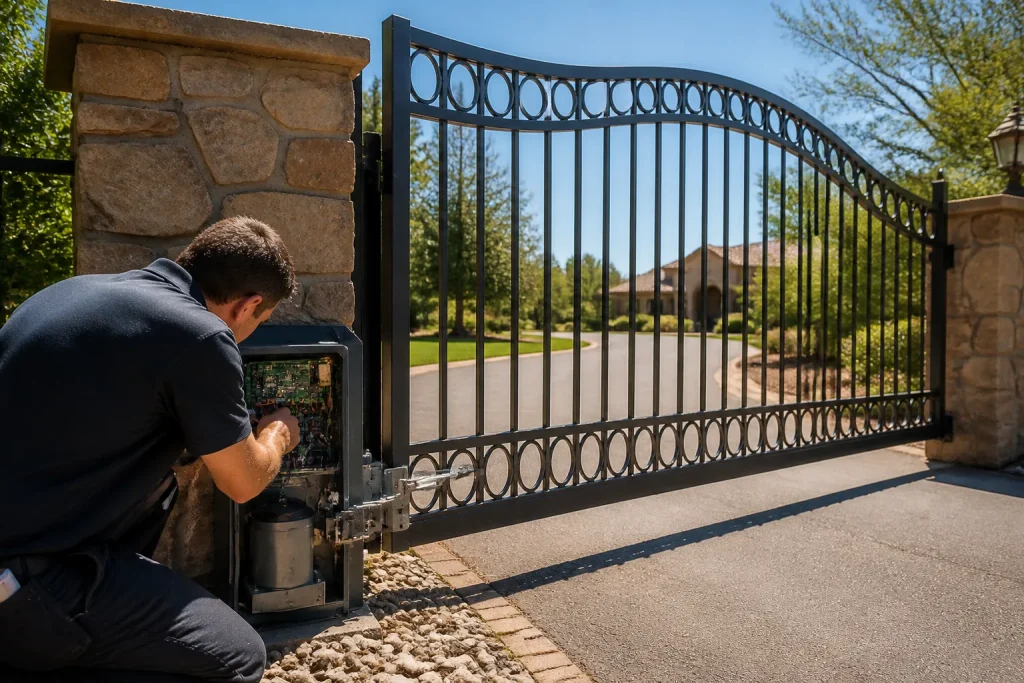
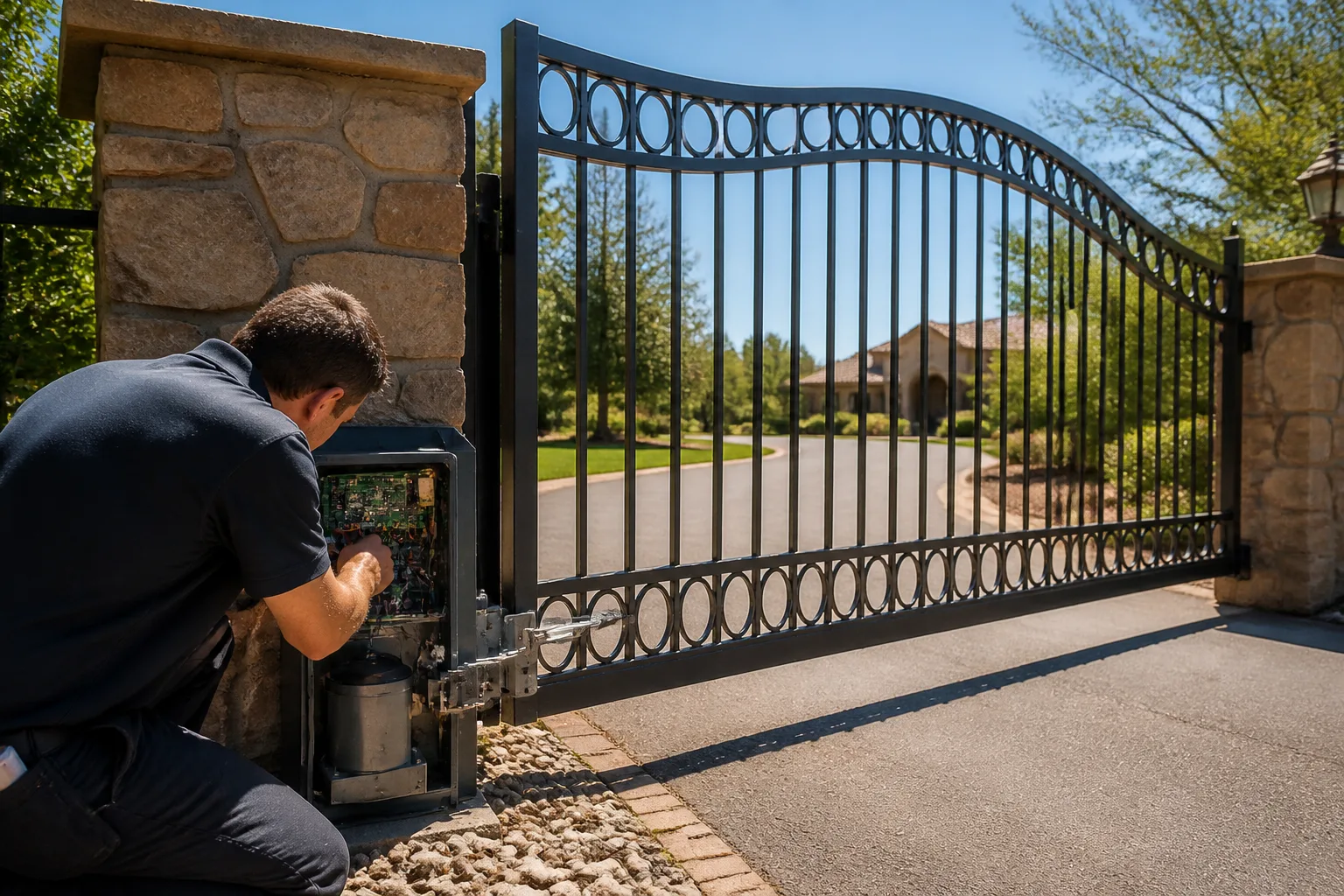
The keypad on your gate that quit last week almost certainly still has 12-volt power running to it. What failed is downstream of that power: a corroded terminal, a stuck relay on the control board, or a wire splice the irrigation schedule soaked for three seasons until it finally gave out. The keypad itself is usually fine. In most Spring Valley access control failures, the answer is repair, and it’s cheaper than the $1,200 system somebody already talked you into replacing. If you’d rather not crawl around in the gravel chasing voltage, call (888) 300-3906 and we’ll take a look.
Here’s how to think about the repair-or-replace question the way we do when we pull up to a gate.
Why Most Access Control “Failures” Aren’t the Keypad
When a gate stops responding to a code, the instinct is to blame the thing with the buttons. That’s backwards. The keypad is the last stop in a chain: transformer, control board, wiring run, splice points, then the keypad. A failure anywhere upstream shows up as “the code doesn’t work,” and the keypad gets condemned for something it didn’t do.
In our experience, roughly eight out of ten access control calls trace back to power, wiring, or a single failed component, not the reader itself. That matters because a keypad replacement runs a few hundred dollars installed while the actual culprit is often a $15 transformer or a corroded splice cap. We’ve fixed systems that a previous company had already written off, and the owner was one signature away from paying for a whole new system to solve a ten-minute continuity problem.
The Two Checks That Diagnose 80 Percent of Failures
Before anyone condemns a component, two measurements settle most of it. These are the checks we run on every access control call in Spring Valley, and they’re also the step that gets skipped when a truck rolls up and starts quoting replacement.
- Voltage at the keypad. Confirm the reader is actually receiving its rated low voltage. If power drops off before it reaches the keypad, the keypad isn’t broken, the run is.
- Continuity along the wire run. Trace the low-voltage wiring from the control board out to the reader. A break, a bad splice, or a partially shorted segment will read as a dead keypad and cost nothing more than a splice kit to fix.
If both checks pass and the gate still won’t open on a code, you’ve narrowed it to the control board or the receiver, and now you’re troubleshooting a specific part instead of guessing. That single sequence is the difference between a $60 repair and a $200 one, and it’s the reason we don’t start by pricing hardware. Gate access control work rewards patience; it punishes throwing parts at a symptom.
Keypad Failure or Control Board Relay? They Look Identical
To you, both problems look the same: you punch the code, nothing happens. Under the hood they’re different animals with different price tags. A failed keypad or reader might run around $60 to repair or swap. A failed relay on the control board is closer to $200, because you’re dealing with board-level work rather than a single reader.
The diagnostic isn’t complicated. Isolate the reader from the board. If the reader sends a signal when you trigger it directly, the reader is fine and the problem sits on the board. If it sends nothing, the reader is the suspect. That test takes minutes, and it stops people from replacing a perfectly healthy keypad to fix a relay they never checked.
We pulled one out of a garage over in Spring Valley last month where the homeowner had already bought a new keypad because “the old one was dead.” The old one wasn’t dead. The control board relay had given up, and the new keypad would have failed exactly the same way. Fix the panel without checking the board and you’ll fix it twice.
Why Spring Valley Irrigation Schedules Eat Low-Voltage Wiring
There’s a local pattern worth knowing. Access control failures in Spring Valley don’t usually announce themselves in the dead of winter. They show up in July, when the gate suddenly won’t take a code. The wire splice that’s been quietly corroding since the previous spring finally gave up in the heat.
Spring Valley’s irrigation schedules keep the ground around gate posts consistently damp through the growing season, and low-voltage splices buried or tucked near the run get soaked over and over. Water plus time equals corrosion, and corrosion equals intermittent failures that seem random until you find the splice. A failing connection that reads fine on a dry Tuesday can drop out the moment the sprinklers finish. That’s why we chase continuity rather than replace parts on a summer call: the seasonal moisture here is the real suspect, and it’s cheap to fix when you find it.
When Access Control Is Actually Worth Replacing
Repair-first doesn’t mean repair-always. There are honest limits, and when you hit one, replacing the system is the smarter money. Watch for these:
- Discontinued telephone entry support. If the manufacturer no longer supports programming your entry system, every change becomes a scavenger hunt.
- No compatible receiver for current remotes. If modern remotes won’t pair because the receiver is obsolete, you’re stuck in the past with no clean upgrade path.
- A system that needs a service call to add a user. If adding a new code requires a technician on site every time, the system is costing you in ways the sticker price never showed. Newer platforms like BFT and Linear let you manage users without a call-out.
Those are real limitations, not sales excuses. If your Spring Valley property sits on one of these, we’ll say so plainly and price a replacement rather than keep patching a system that’s working against you.
What HOA and Rental Owners Need to Hand Over
Here’s the paperwork problem nobody warns you about. When a Spring Valley HOA or rental property changes hands, the access control documentation usually doesn’t. The programming records, master codes, and wiring diagrams that let the next owner manage the system walk out the door with the last manager, and reconstructing them costs real time and money.
What should transfer with the property: the master programming codes, a record of every programmed user and schedule, and a wiring diagram showing how the keypad, board, and power connect. When those are missing, rebuilding them means tracing every run by hand and reprogramming from scratch. If you own a rental or sit on an HOA board in Spring Valley, get that documentation in hand now, before you need it at the worst possible moment. It’s the cheapest insurance an access control system has.
When to Call a Pro
The voltage and continuity checks are genuinely within reach for a handy homeowner. What isn’t: working around 120-volt line power feeding the transformer, and diagnosing a control board where a wrong probe can cook a $200 part. If you’re not comfortable with a multimeter near live power, stop there. That’s the point to call. Our crew carries up to 25 years of experience, we weld and repair on site rather than haul your gate away, and every job is backed in writing by our 90-Day Done Right Promise. We’re certified on nine major gate brands, so whether you’re running a Viking reader or a Ghost Controls operator, we’ve likely seen your exact failure before.
Related services in Spring Valley: if your issue turns out to be mechanical rather than electronic, see our Gate Repair in Spring Valley page, or if the operator itself is the problem, our Gate Motor & Opener in Spring Valley team handles that. Starting fresh? Our Gate Installation in Spring Valley page covers new systems, and you can always reach us through the Gatewood Fence & Gate Spring Valley home page.
The Bottom Line
Most access control failures in Spring Valley are a power problem, a wiring splice, or one failed component, and they’re worth an hour of honest diagnosis before anyone prices a replacement. Check voltage at the keypad, check continuity along the run, then isolate the reader from the board. That sequence tells you whether you’re looking at a $60 fix or a $200 fix, and it keeps a good system out of the dumpster. Replace only when the system’s limits are real: dead support, no modern receiver, or a platform that needs a service call just to add a user.
If you’re in Spring Valley and need help deciding, Gatewood Fence & Gate Spring Valley offers free estimates. We’re locally owned and owner-operated, a live person answers the phone around the clock, and there’s no trip charge inside the county. Call (888) 300-3906 and we’ll give you a straight answer on repair or replace.
Frequently Asked Questions
Most access control repairs in Spring Valley run from about $60 for a keypad or splice fix to roughly $200 for a control board relay repair. The exact figure depends on what the diagnostics find, and we quote and agree on the price before any work starts, so the invoice matches the estimate. Call (888) 300-3906 for an exact quote; estimates are free.
Often, yes. Access control failures are frequently same-day calls for us in Spring Valley, because most trace back to a loose splice or a power issue we can diagnose on the spot. Call (888) 300-3906 and we’ll tell you honestly when we can be there.
Repair is cheaper in most cases, because the failure is usually a single component or a wiring splice rather than the whole system. Replacement makes sense when the manufacturer has dropped support, modern remotes won’t pair, or adding a user code requires a service call. We’ll walk you through both options with real numbers before you decide.
They can be reconstructed, but it means tracing every wire run and reprogramming the system from the master level, which takes time and costs more than having kept the records. If you’re buying or managing a Spring Valley property, request the master codes, user records, and a wiring diagram before the sale closes. Call (888) 300-3906 and we’ll help you sort out what’s recoverable.
Written by the team at Gatewood Fence & Gate Spring Valley.
Need Gate Repair Help?
Call Gatewood Fence & Gate Spring Valley - licensed & insured, here with fast after-hours help in Spring Valley.
(888) 300-3906