
Mighty Mule Gate Repair in Spring Valley: A Homeowner’s Guide
Mighty Mule’s weight and gate-width ratings are tested on flat ground in controlled conditions. A 400-pound rating on a Mighty Mule means 400 pounds on flat ground, which is not the same as 400 pounds on a gate that starts uphill and has a slight wind load from an open side yard. That single gap between the spec sheet and the driveway explains a large share of the Mighty Mule failures we get called out to in Spring Valley – and it’s why the first thing we do is figure out whether the product fits the job or the job outgrew the product. If you’d rather not sort that out yourself, call (888) 300-3906 and we’ll take a look.
Key Takeaways
- Most Mighty Mule failures in Spring Valley are application problems, not product defects – long driveways, heavy gates, and solar panels that don’t see enough sun.
- The battery and charging system is the number one culprit: a “battery low” light can mean a dead battery, a failed charge controller, or a panel that’s shadowed all afternoon.
- Mighty Mule’s swing arm runs on tighter tolerances than most operators, so a bracket that’s shifted even a little puts a sideways load on the actuator rod and wears it out early.
- Some parts are field-repairable; others need a full operator swap. Knowing which is which is where the money is saved.
Is your Mighty Mule broken, or was it the wrong operator for the job?
This is the question that decides everything, and it’s the one most folks skip. A Mighty Mule that keeps failing on a long, sloped Spring Valley driveway may be doing exactly what it was built to do – it just wasn’t built for that driveway. The operator isn’t defective. The match is wrong.
Here’s how we separate the two:
- Product problem: The gate is within the operator’s weight and width rating, the ground is reasonably flat, the solar panel gets sun, and it still fails. That’s a genuine defect or a worn component, and repair or replacement of the part solves it.
- Application problem: The gate is heavier than rated, the driveway runs uphill, the run is longer than the operator’s spec, or the panel sits in shade most of the day. In that case you’re asking a light-duty operator to do heavy-duty work, and no amount of repair will fix that for long.
We pulled one out of a garage over in the Foothill neighborhood last week where the homeowner had replaced the battery twice in two years. The battery wasn’t the problem. The gate had been rebuilt with a heavier frame and the operator was never resized to match. We’ve serviced Mighty Mule for years alongside Linear and Ghost Controls, and the pattern holds across all of them: the operator gets blamed, but the gate is what changed.
Mighty Mule battery and charging problems: what the “low battery” light is really telling you
A “battery low” indicator on a Mighty Mule almost never means the battery alone is the problem. It means the charging system isn’t keeping up, and that can come from three different places. Testing the battery without testing the charger is how people end up buying the same battery a third time.
- The battery itself is at end of life. These are sealed lead-acid batteries and they age out. A battery that won’t hold a charge on a bench test is genuinely done.
- The solar panel isn’t producing enough. This is common in Spring Valley yards where a panel gets morning sun but sits in shadow from a wall or tree by early afternoon. The panel is fine; it just isn’t seeing enough light to keep the battery topped off.
- The charge controller has failed. This is the sneaky one. The panel is putting out voltage, the sun is fine, but the controller isn’t passing that charge to the battery. On a meter the panel looks healthy, which is exactly why people miss it.
Testing in that order – battery, then panel output, then controller – saves you from throwing parts at it. If you’re on solar and your gate dies every few weeks, the controller is the first place we look after the battery tests good.
Mighty Mule swing arm alignment: why a small bracket shift matters
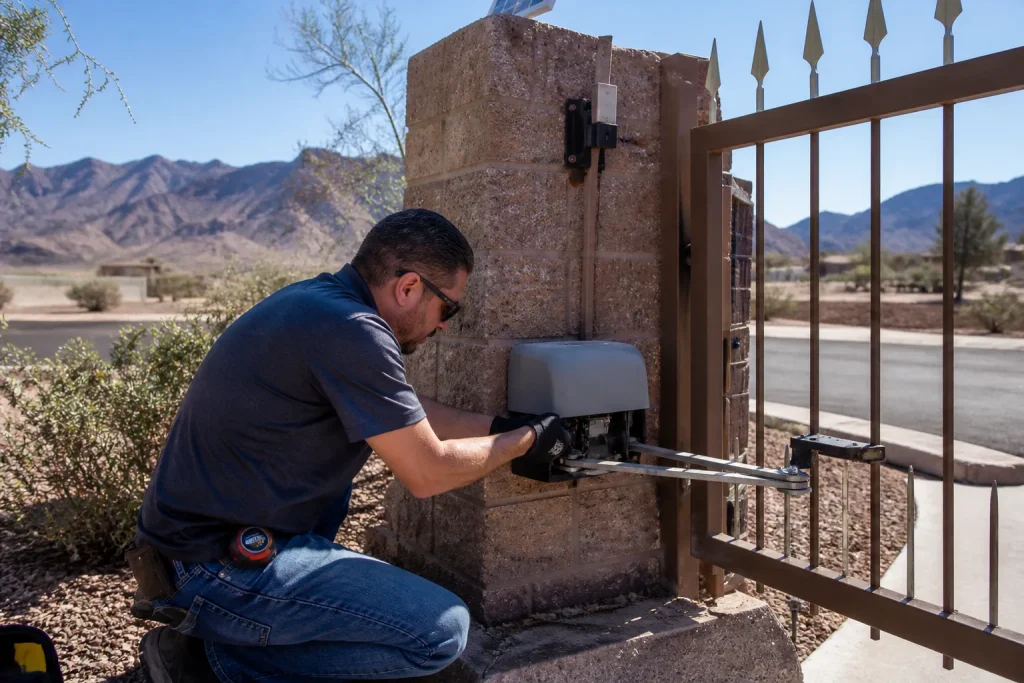
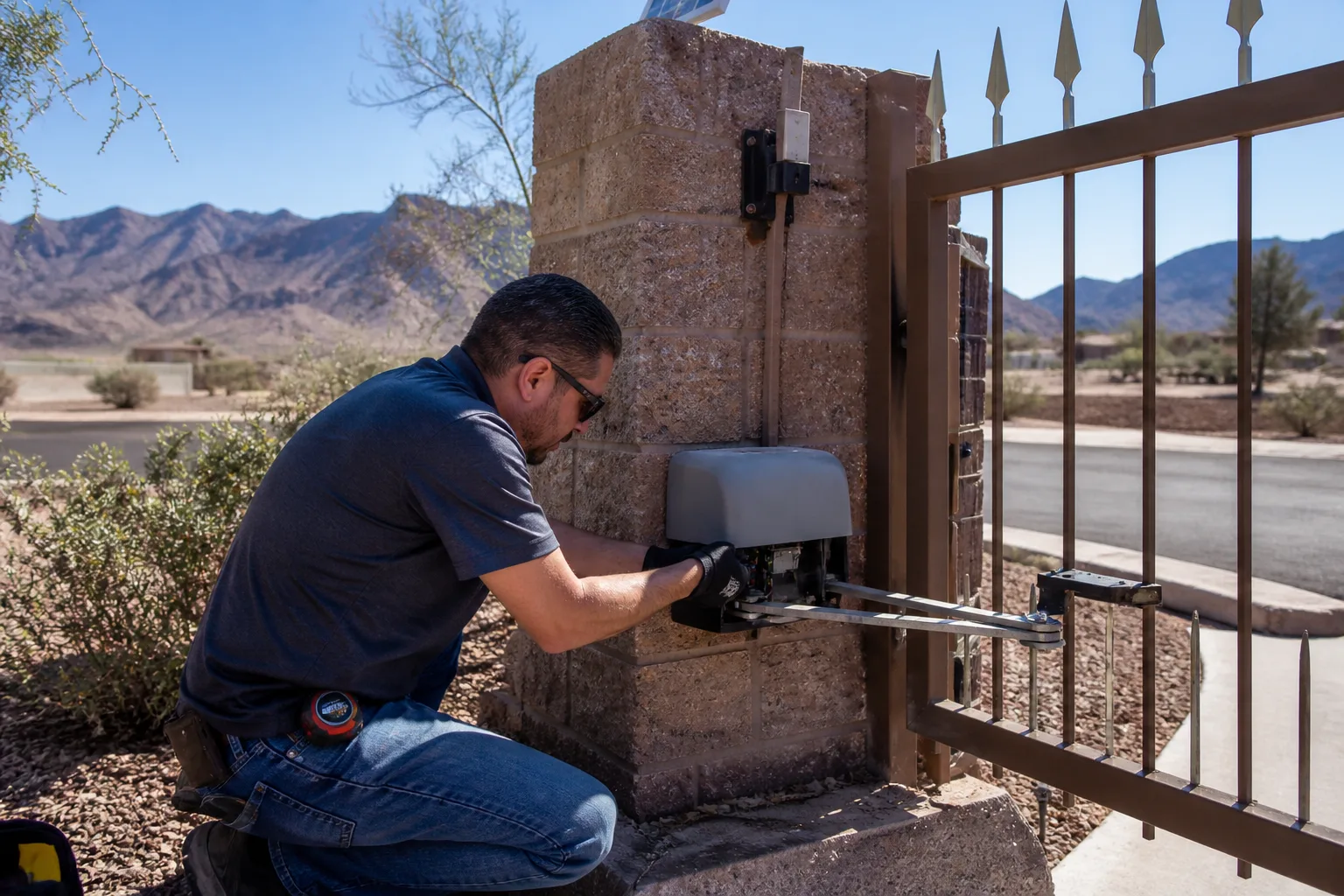
Mighty Mule’s swing operator runs on tighter arm geometry than most of the swing operators we service. The actuator rod has to travel in a straight line relative to the bracket, and a bracket that’s off by even a small amount sends a sideways load into that rod every time the gate moves. It doesn’t fail immediately. It wears – gradually, quietly, and then one day the gate binds and the operator gives up.
What we check on a Mighty Mule swing arm:
- Bracket-to-post alignment: the mounting bracket has to sit square to the gate’s travel, not twisted by a fraction of an inch from a post that’s settled or swollen.
- Post condition: a gate sags in the hinge post, not in the middle – and that’s where we start. If the post has shifted, the arm geometry has shifted with it.
- Rod angle through the full swing: we watch the rod through the whole arc, not just at rest, because a bind shows up mid-travel where it’s easiest to miss.
Show me the gate closing on its own and I’ll show you where it’s failing. A gate that drifts shut doesn’t need a new operator – it needs the post and the brackets squared up before the actuator rod gets any more wear.
Mighty Mule remote not working? It might be interference, not a bad receiver
In denser Spring Valley neighborhoods, a Mighty Mule remote that works one day and not the next often isn’t a failing receiver at all. It’s radio frequency interference. Neighbors’ gate systems, smart home devices, and commercial wireless equipment all share the same crowded bands, and a remote that competes for that airspace can act exactly like a dying receiver.
The tell is in the pattern. A genuinely failing receiver usually gets steadily worse. An interference problem is erratic – works fine in the morning, dead at 5 p.m. when the neighborhood comes home and everything powers up. We’ve seen the same symptoms on Viking and DoorKing systems, so it’s not a Mighty Mule quirk; it’s just more noticeable on home-grade operators.
Before anyone replaces a receiver, check the remote type and frequency. Sometimes swapping to a different remote or re-pairing solves it outright. Replacing a receiver that was never bad is an expensive way to learn that lesson.
What’s repairable on a Mighty Mule, and what needs a full swap
This is where homeowners save real money, and where a shop that would rather sell you a new operator costs you. Not every Mighty Mule failure means a new unit, and not every part is worth repairing. Here’s the honest split:
- Field-repairable: batteries, solar panels, charge controllers, remotes and receivers, brackets, and actuator arms. These are the parts that fail most often, and most are replaceable on site.
- Full operator swap: a burned-out control board on an older unit, a motor that’s seized, or a housing that’s cracked and letting water in. At that point the repair costs approach a replacement, and we’ll tell you straight.
- Genuinely borderline: a worn gear train on a unit that’s otherwise sound. Sometimes worth fixing, sometimes not – it depends on the gate it’s driving.
The other thing worth knowing: you don’t have to go through a dealer to get Mighty Mule replacement parts, and the dealer markup on common components can be significant. We source parts directly and pass along what the part actually costs. No-hassle upfront pricing is the whole point – you get the number before the work starts, and it doesn’t move at the door.
When to call a pro
A battery swap and a remote re-pair are reasonable things to handle yourself. Beyond that, the work gets into spring-loaded mechanisms, low-voltage wiring, and 120-volt power runs, and that’s where a homeowner can get hurt or make a small problem bigger. Gate operators hold stored energy and move heavy things; a bracket that lets go under load is genuinely dangerous. A trained tech is the right call for anything past the simple checks.
We’re certified to service nine major brands, Mighty Mule included, and our technicians have up to 25 years of experience. Every job carries the 90-Day Done Right Promise in writing – if it’s not done right, we make it right, one call brings us back. We answer the phone live, 24/7, and there’s no trip charge inside the county.
Related services in Spring Valley: if your Mighty Mule problem turns out to be the gate itself, start with Gate Repair in Spring Valley. If your operator has outgrown the gate and you’re weighing a replacement, see Gate Motor & Opener in Spring Valley or Gate Installation in Spring Valley. And you can always start at the Gatewood Fence & Gate Spring Valley home page.
The Bottom Line
Most Mighty Mule problems in Spring Valley come down to one question: was the operator matched to the gate, or not? If it was, the fix is usually a battery, a charge controller, a bracket squared up, or a remote that’s fighting the neighbors’ signal – all field-repairable and none of it requiring a new unit. If it wasn’t, you’re better off resizing the operator than pouring money into repairs that won’t hold. We repair what other shops want to replace, and we’ll tell you which side of that line you’re on before anyone touches the gate.
If you’re in Spring Valley and need help, Gatewood Fence & Gate Spring Valley offers free estimates – call (888) 300-3906. There’s a free second opinion on any written estimate, $40 off any repair over $200, and a permanent 10% discount for seniors and veterans.
Frequently Asked Questions
Most Mighty Mule repairs in Spring Valley run from about $150 to $400 depending on the part – battery and controller work sits at the lower end, actuator arm or bracket replacement at the higher end. A full operator swap costs more. You get the exact number before work starts, and it doesn’t change at the door. Call (888) 300-3906 for an exact quote – estimates are free.
Often yes, depending on the day and what’s needed. Most battery, bracket, and remote issues we can handle on the first visit. Call (888) 300-3906 and we’ll give you a real window, not a maybe.
Because the battery usually isn’t the real problem – the charging system is. Either the solar panel isn’t getting enough sun or the charge controller has failed and isn’t passing charge through. Both look identical from the keypad. A tech can test panel output and controller function in minutes. Call (888) 300-3906 for a free estimate.
No. Common Mighty Mule components like batteries, controllers, brackets, and remotes are available without dealer markup, and we source them directly. That’s part of why a repair here often costs less than folks expect. Call (888) 300-3906 for a quote – estimates are free.
It can be repaired, but the repairs won’t last if the operator stays undersized for the gate. An overloaded operator wears out its parts faster, and eventually you’re replacing it anyway. The honest answer is usually to resize the operator to match the gate, and we’ll tell you that straight. Call (888) 300-3906 for a free estimate.
Written by the team at Gatewood Fence & Gate Spring Valley.
Need Gate Repair Help?
Call Gatewood Fence & Gate Spring Valley - licensed & insured, here with fast after-hours help in Spring Valley.
(888) 300-3906