
5 Mistakes to Avoid With Gate Motor & Opener
The five worst things that happen to gate motors in Spring Valley are almost always caused by installation and setup decisions made in the first week, not by the equipment wearing out. Wrong voltage, a mounting angle a few degrees off spec, no thermal protection, no debris seal, and set cycle limits that ignore how the gate actually gets used – every one of those problems happens before the motor has done a single honest day of work. About half the failed gate motors we’ve pulled out were killed by the installation, not the years of service. The motor never had a fair shot.
If you’d rather not climb this learning curve yourself, call (888) 300-3906 and we’ll take a look before the motor pays for somebody else’s shortcut.
Key Takeaways
- Voltage drop from a shared circuit can degrade motor windings in 12 to 18 months – and it’s measurable on day one.
- Linear actuators need to hit the manufacturer’s mounting angle exactly, or the arm binds and the motor draws excess current on every cycle.
- A manual release you’ve never tested is not a manual release. It’s a hope.
- A ten-dollar debris seal is the cheapest brush-life insurance you can buy in Spring Valley’s dust.
- Cycle ratings assume rest time. A busy driveway or a short-term rental needs a commercial-rated unit.
1. Running the Opener on a Shared Circuit
A gate operator needs its own circuit, sized for the motor’s actual draw. What we find instead, over and over in Spring Valley, is an operator tapped into a circuit that also feeds landscape lighting, an irrigation controller, or a shed outlet. On paper it works. In practice the voltage sags every time something else on that circuit kicks on, and the motor windings take the hit cycle after cycle.
This doesn’t fail dramatically. It degrades. A motor on a starved circuit often runs fine for 12 to 18 months and then starts stalling, overheating, or tripping its breaker for no reason the homeowner can see. By the time we’re called out, the diagnosis is easy: put a meter on the supply and watch what happens when the irrigation controller fires. The drop is right there.
Why nobody catches it: the installer wires it up, the gate opens, the job looks done. Checking voltage under load on day one takes five minutes. Skipping it costs the homeowner a motor.
- What to check: Does the operator have a dedicated breaker? Is anything else on that circuit?
- What it looks like when it’s wrong: Dimming lights at the gate when the motor runs, intermittent stalls, a warm motor housing after light use.
- Spring Valley factor: Long rural driveway runs make voltage drop worse. Distance adds resistance, and a marginal circuit gets worse with every foot of wire.
2. Mounting a Linear Actuator a Few Degrees Off Spec
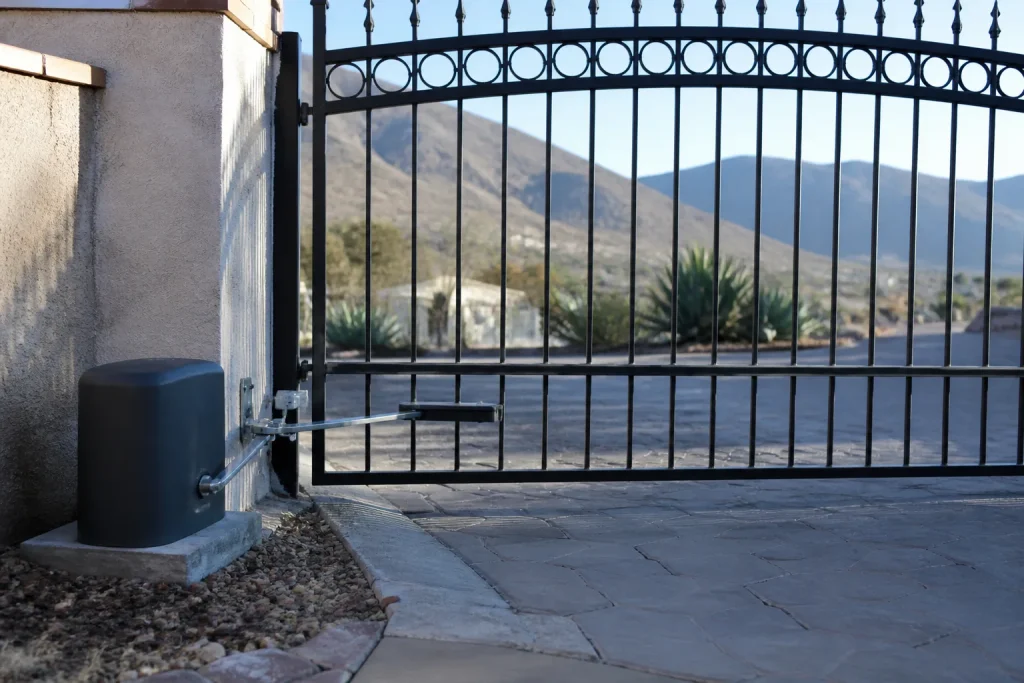
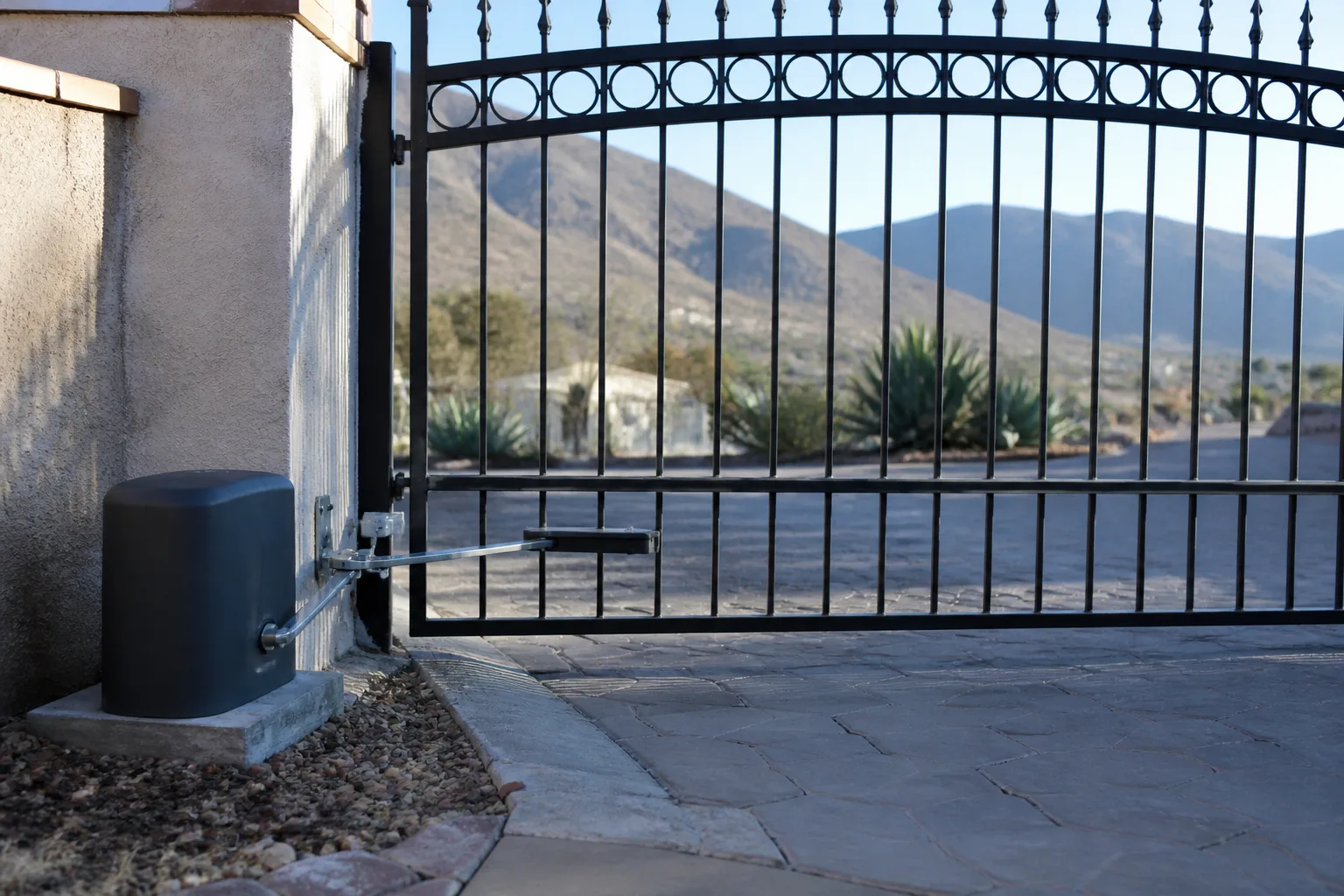
Linear actuators – the arm-style operators common on residential swing gates – are picky about angle. The manufacturer publishes a mounting geometry for a reason: the arm has to push and pull through a specific arc, and if it’s a few degrees off, the geometry fights itself. The gate still opens. It just does it with a binding load the motor has to overcome on every single cycle.
That binding load shows up as excess current draw. The motor runs hotter, the gearbox works harder, and the whole assembly ages faster than it should. We’ve pulled Linear and Viking arms off gates in Spring Valley where the bracket was mounted by eye and the arm was fighting the hinge geometry from day one. The motor didn’t fail because it was cheap. It failed because it was doing extra work it was never rated for.
This is also why a gate that “worked fine for two years” suddenly starts reversing halfway. The motor’s been compensating for the bind, and eventually the current sensor trips and the gate goes back. Homeowners read that as a sensor problem. It’s usually a mounting problem that finally got loud enough to notice.
If your gate reverses on its own or the arm looks like it’s straining, that’s worth a look before it becomes a motor replacement. Our Gate Motor & Opener in Spring Valley service covers exactly this kind of diagnosis.
3. Never Testing the Manual Release
Every automatic gate operator has a manual release so you can open the gate by hand during a power outage. Almost nobody tests it. That’s the mistake. A release that was installed wrong, seized from grit, or never lubricated is not a release – it’s a gate that traps you on the wrong side of your own driveway during the one outage that matters.
The test is simple, and it should happen the day the operator is installed and again every season: with the gate closed and the motor off, engage the release, swing the gate by hand, then reset it and confirm the motor re-engages and runs normally. If the gate won’t move freely by hand, the release isn’t doing its job. If the motor doesn’t re-engage cleanly, the release mechanism is out of adjustment.
We pulled one out of a garage over in the Spring Valley area last month where the release key had never been turned since installation. It took a penetrating oil soak and a pair of pliers to free it. The homeowner had been counting on that lever for years without ever knowing it was frozen solid.
Spring Valley’s dust and temperature swings are hard on release mechanisms. Grit works into the pivot, grease dries out, and the lever that moved freely at installation seizes up quietly over a couple of seasons. Test it before you need it.
4. Skipping the Debris Seal and Housing Inspection
Spring Valley sits on ground that turns to fine caliche dust the moment it dries out. That dust gets everywhere, including inside an unsealed motor housing, where it acts like an abrasive on the commutator brushes. Every cycle grinds a little more material off the brushes. A motor that should last many years wears out early, and the homeowner blames the brand instead of the missing seal.
A debris seal and a proper housing inspection belong on every installation. It’s a small part with a small price tag, and it extends brush life by years in this climate. We check the housing on every motor service call for exactly this reason – if the seal is missing or torn, the brushes are already wearing faster than they should.
Housing inspection means more than glancing at it. Look for:
- Gaps where the housing meets the mounting bracket
- A seal that’s dried, cracked, or simply absent
- Dust buildup inside the housing when it’s opened
- Worn or scored brushes that point to grit intrusion
If you’re having a motor installed anywhere in Spring Valley, ask whether the seal is part of the job. If the answer is vague, that’s your answer.
5. Setting Cycle Limits for the Wrong Kind of Use
Every residential operator has a maximum cycle rating, and that rating assumes adequate rest time between operations. A gate that opens and closes a few times a day is well within spec. A gate on a busy family driveway, or one serving a short-term rental where guests come and go at all hours, is a different story. Run a residential-rated unit past its duty cycle and it overheats, wears out early, and eventually quits.
This is the expensive lesson, because the homeowner only finds out the rating was too low after the motor fails. In Spring Valley, short-term rentals and multi-car households are exactly the situations where a commercial-rated operator belongs from the start. The price difference upfront is small compared to replacing a burned-out residential unit and paying for installation twice.
Here’s the plain version: match the operator to the actual traffic, not the traffic you expect. If the gate sees twenty, thirty, forty cycles a day, tell whoever’s quoting the job. A DoorKing or Ghost Controls unit rated for the load will outlast a lighter operator every time, and the person installing it should be the one to flag the duty cycle before a motor goes in the ground.
When to Call a Pro
Some of these checks you can do yourself – look for the seal, test the manual release, notice if the motor housing runs hot. But voltage testing under load, actuator geometry, and duty-cycle sizing are diagnosis-and-spec work, and getting them wrong is how homeowners pay twice. For gate repair in Spring Valley, a professional look at the installation is worth more than a replacement quote. Our Gate Repair in Spring Valley and Gate Installation in Spring Valley pages cover how we handle each.
Related Services in Spring Valley
We service nine major gate brands – LiftMaster, FAAC, BFT, Linear, Viking, Ghost Controls, DoorKing, Elite, and Mighty Mule – and we weld on site so the gate stays in your driveway. You can see the full range on our Gatewood Fence & Gate Spring Valley home page. Every job carries our 90-Day Done Right Promise in writing, and a live person answers the phone around the clock.
The Bottom Line
Almost every one of these mistakes is cheaper to prevent than to fix. A dedicated circuit, a correct mounting angle, a working manual release, a ten-dollar debris seal, and an operator rated for real traffic – that’s the whole list. Get those right on day one and the motor has a fair shot at a long life.
If you’re in Spring Valley and need help, Gatewood Fence & Gate Spring Valley offers free estimates. Call (888) 300-3906 and we’ll take a look. Standing offers include $40 off any repair over $200 and no trip charge inside the county, plus a free second opinion on any written estimate.
Frequently Asked Questions
Look for a motor that runs hot after light use, a gate that reverses on its own, or an arm that looks like it’s straining. Those point to a shared circuit, a mounting angle off spec, or a duty-cycle mismatch. A professional voltage check and a look at the actuator geometry will confirm it quickly. Call (888) 300-3906 for a free estimate.
Every season, and again any time the gate has sat unused for a stretch. With the motor off and the gate closed, engage the release, swing the gate by hand, reset it, and confirm the motor re-engages and runs normally. If it won’t move freely or won’t reset, the release needs attention before an outage finds you.
Usually, yes. Residential operators have a maximum cycle rating that assumes rest time between operations, and rental traffic can blow past that quickly. A commercial-rated unit from DoorKing, Ghost Controls, or another major brand costs a little more upfront and saves you from replacing a burned-out residential motor. Call (888) 300-3906 and we’ll size it to your actual traffic.
Repeat failures almost always trace back to the installation, not the motor. A starved circuit, a binding actuator, or grit getting past a missing debris seal will wear out any brand early. Before you replace the motor again, have the supply voltage and mounting checked. Our technicians have up to 25 years of experience with this diagnosis – free estimates available.
Written by the team at Gatewood Fence & Gate Spring Valley.
Need Gate Repair Help?
Call Gatewood Fence & Gate Spring Valley - licensed & insured, here with fast after-hours help in Spring Valley.
(888) 300-3906