
5 Mistakes to Avoid With Gate Installation
The gate that’s dragging on your concrete right now probably dragged a little on the day it was installed. Somebody saw it and didn’t say anything, figured it was close enough, and left before you noticed. That is the pattern behind nearly every failed gate installation we get called out to in Spring Valley: the problem was baked in on day one, and it takes about 18 months for the consequences to show up. The five mistakes below are the ones we see most, and every one of them is cheaper to prevent than to fix.
If you’d rather not sort through it yourself, call (888) 300-3906 and we’ll walk you through what a proper install should include.
Key Takeaways
- Most gate failures start with an undersized post footing, not a bad gate.
- Operator torque is matched to actual gate weight, never an estimate.
- Driveway slope decides whether a swing gate clears the ground at full open.
- Low-voltage wiring run next to irrigation causes intermittent faults that are hard to trace.
- A gate that wasn’t force-tested with a vehicle was never actually commissioned.
1. Skimping on Post Depth and Concrete Footing
Post lean is the single biggest killer of an otherwise good gate, and it almost always traces back to a footing that was too shallow. Around Spring Valley, the soil layers make this worse than most installers account for. Caliche – that hard, cemented layer you hit a few feet down – acts like a shelf. A post set just above it looks solid on day one because the concrete grabbed the caliche, but the footing never reached stable ground beneath. The first wet winter and the gate starts to lean.
What a proper Spring Valley installation accounts for:
- Footing depth sized to the gate, not a guess. A wide, heavy driveway gate needs a deeper, wider pier than a lightweight walk gate. One-size footings are how posts fail.
- Breaking through the caliche instead of sitting on it. The footing has to reach stable soil, which sometimes means going deeper than a fast installer wants to.
- Proper concrete volume and cure time. Hanging a heavy gate on a footing that hasn’t cured is a quiet way to guarantee a lean.
We’ve pulled gates out of the ground in Spring Valley where the post footer was barely a foot deep. The hinge was fine. The gate was fine. The footing was the whole problem. If you’re replacing a gate, look at the footer before anything else. For full replacement work, our Gate Installation in Spring Valley page covers what a properly built install looks like.
2. Matching the Operator to Estimated Weight Instead of Actual Weight
This one hides for a while and then eats motors. An operator rated for a 400-pound gate will run a 440-pound gate – for a while. Then the motor overheats, the gearbox wears early, and the unit quits well before the warranty period is up. We’ve seen gates fail at 14 months on a LiftMaster operator that was correctly sized for the weight the installer guessed, not the weight the gate actually is.
Gate weight isn’t something you eyeball. Steel frame, pickets, hinges, and hardware add up fast, and two gates that look identical can differ by 80 pounds. The right way:
- Weigh or calculate the actual gate. Steel density times volume, plus hardware, gives a real number, not a guess.
- Add a safety margin. A 10 percent underestimate is the difference between a motor that lasts a decade and one that dies young.
- Match the brand to the job. A FAAC or BFT operator rated for the real weight behaves completely differently than an undersized unit pushed to its limit.
When we size an opener, we start from the actual gate – not the number on a spec sheet. Our Gate Motor & Opener in Spring Valley page walks through how the rating should be matched.
3. Skipping the Driveway Slope Calculation
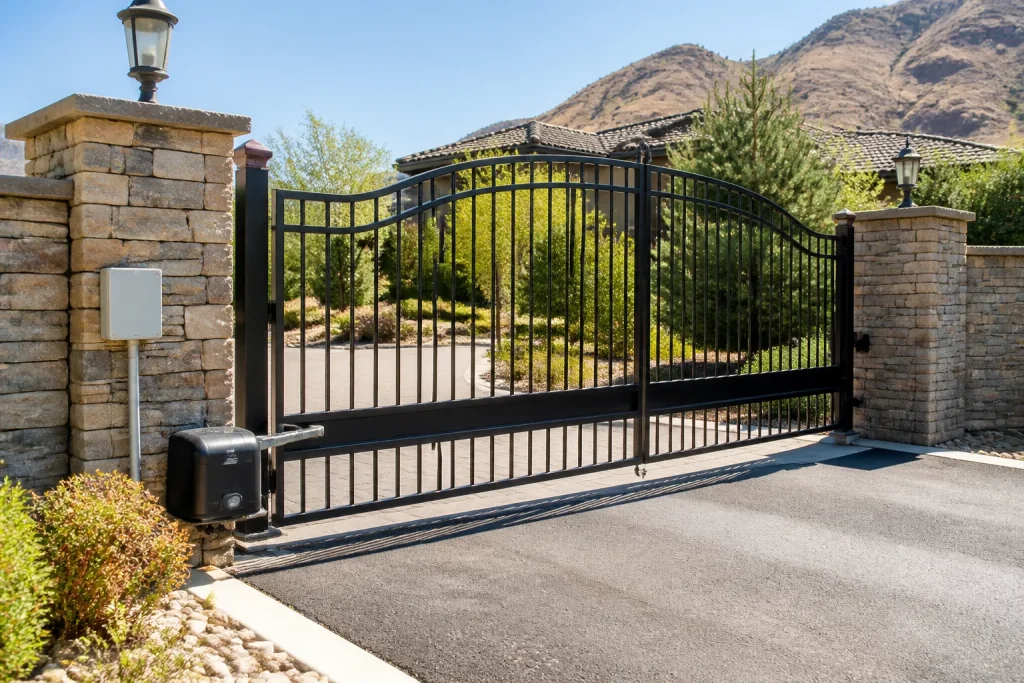
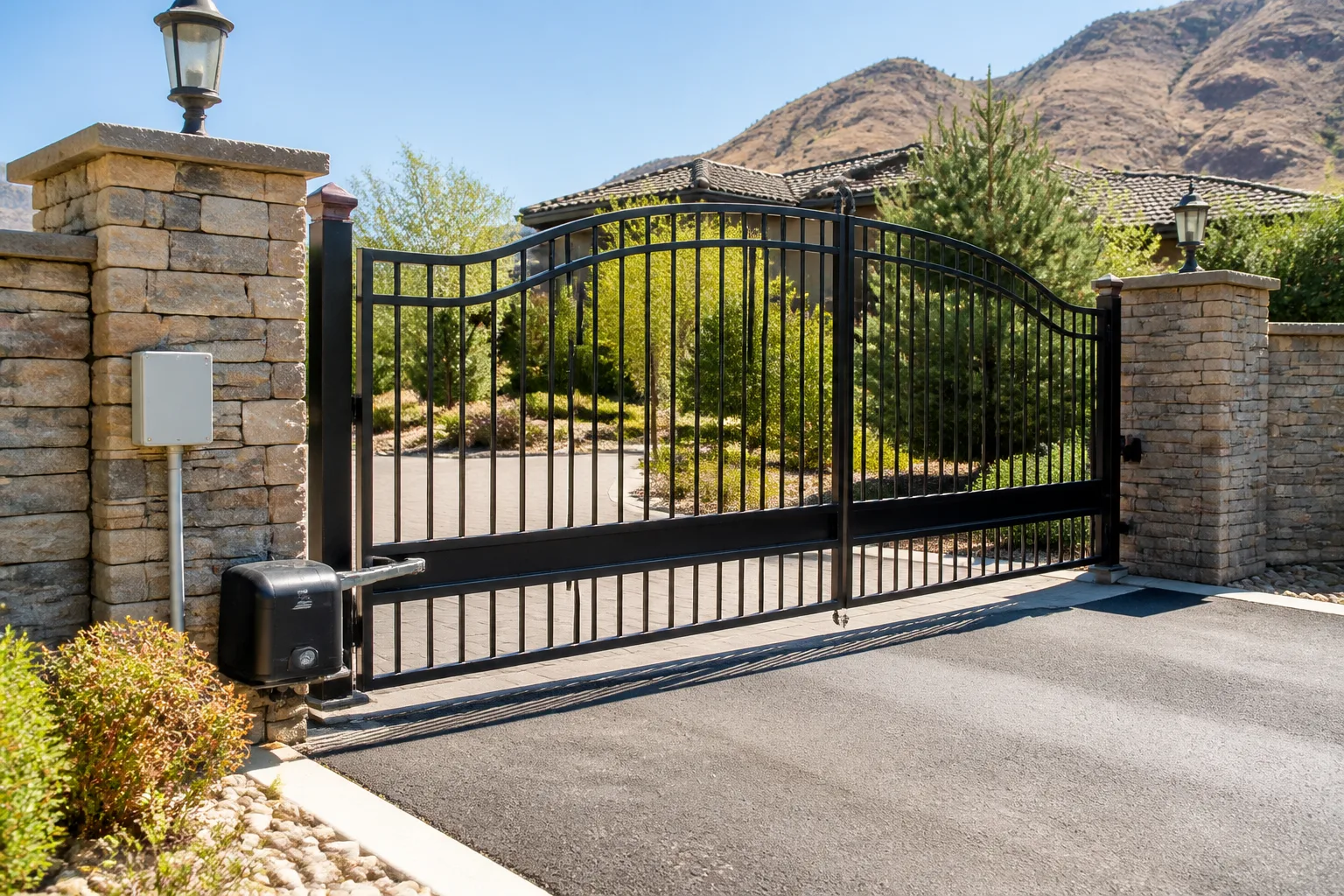
Here’s the step that gets cut on fast installs and costs the most later: figuring out whether a swing gate will clear the ground at full open. Your driveway isn’t flat. It rises or falls toward the street, and that grade changes the arc a swing gate travels. Get it wrong and the gate scrapes the concrete at the bottom of its swing, or worse, hits the ground hard enough to bind the operator.
The fix later is ugly. You’re either grinding concrete to give the gate clearance, or relocating the operator and re-hanging the gate to change the arc. Both are far more expensive than the ten minutes of measuring that should have happened before the first post went in the ground.
What a Spring Valley installer should measure before digging:
- The rise and fall of the driveway across the full gate opening, at both hinge and latch sides.
- Ground clearance at the lowest point of the gate’s travel arc, at full open.
- Whether the grade calls for a different hinge height, a different operator position, or a gate type that handles slope better.
Spring Valley’s driveways aren’t uniform, and a grade toward the street is common. If your driveway has any slope at all, that measurement is not optional. It’s the difference between a gate that runs clean for 20 years and one that gets ground down in year two.
4. Running Low-Voltage Wiring in the Same Trench as Irrigation
The operator needs low-voltage control wiring run out to it – the safety loop, the keypad, the exit wand, whatever’s on the gate. This gets buried, and it’s tempting to share a trench with the irrigation lines already dug for the yard. Don’t. Running control wiring in the same trench as irrigation without separation causes interference that shows up intermittently, and intermittent electrical faults on a gate are the most maddening thing to diagnose.
The symptoms are never clean. The gate opens fine most days, then phantom-trips at 6 a.m. The safety loop false-triggers when the sprinklers run. The keypad works until it doesn’t. All of it points back to a wiring run that should have been separated from day one.
What goes wrong with a shared trench:
- Induced interference. AC current in irrigation valve wiring couples into the low-voltage control lines and creates noise the gate controller misreads.
- Moisture and vibration. Irrigation lines move and take on water; control wiring lying next to them picks up moisture and corrosion at the splices.
- Diagnosis is a nightmare. Because the fault only shows up under certain conditions, an installer hunting it can replace the whole control board and still not fix it.
The wiring run should be planned like part of the gate, not an afterthought. Separated conduit, proper depth, moisture-protected splices. If your gate on a Spring Valley property is doing something weird only when the sprinklers run, that wiring is where we start.
5. Never Testing Obstruction Force and the Safety Loop With a Vehicle
A gate that was switched on was not necessarily commissioned. Those are two different things, and the gap between them is where injuries and damage happen. The obstruction force setting tells the operator how hard it can push before it reverses. If it’s not set correctly, a gate can push on a car – or a person – before it backs off. The safety loop tells the gate something is in the way and it should stop. Both need to be tested on the day of installation, and force needs to be tested with a real vehicle, not just a hand.
A hand test tells you the operator reverses when it hits something soft. It doesn’t tell you what happens when a 4,000-pound car is in the path. That’s a force setting tuned wrong, and the homeowner doesn’t find out until it matters.
The commissioning step that should never get skipped:
- Set the obstruction force per the manufacturer spec – LiftMaster, Linear, and the rest all publish the number, and it has to match the gate and the environment.
- Test the safety loop with a vehicle in the path and confirm the gate reverses cleanly.
- Test every safety device – photo eyes, edge sensors, keypad – with the gate moving, not sitting still.
If you don’t know whether this was done on your gate, it’s worth having checked. It’s one of the first things we verify when we’re called out on a Spring Valley installation.
When to Call a Pro
Some of this is honestly something a careful homeowner can inspect – you can look at a post for lean, you can watch whether the gate clears the ground at full open, you can test whether the safety loop stops the gate with a car in the way. What you shouldn’t do yourself is dig new footings, hang a heavy gate, or re-set an operator. That work needs proper equipment, an understanding of the soil and grade, and a real commissioning pass. A gate that falls or pushes on someone is a serious hazard, and the margin for error is small.
If any part of what you’ve read sounds like your situation, that’s the call. Our Gate Repair in Spring Valley service is built around fixing what’s already there instead of replacing it, and we’re happy to give you a free second opinion on any written estimate you’ve received. For a full picture of how we work in the area, start at our Gatewood Fence & Gate Spring Valley home page.
Related services in Spring Valley: Gate Repair in Spring Valley · Gate Installation in Spring Valley · Gate Motor & Opener in Spring Valley
The Bottom Line
Most gate installation failures are set up on day one and the homeowner doesn’t see the consequences for a year and a half, by which point the company that did it has moved on. Post depth that doesn’t break through the caliche, operator torque matched to a guess, a skipped driveway slope calculation, wiring buried next to the irrigation, and a gate that was switched on but never force-tested with a vehicle – those are the mistakes to watch for, and each one is cheaper to prevent than to fix.
If you’re in Spring Valley and need help, Gatewood Fence & Gate Spring Valley offers free estimates. Every job comes with our 90-Day Done Right Promise in writing, and a live person answers the phone 24/7 – call (888) 300-3906.
Frequently Asked Questions
An undersized post footing, by a wide margin. Posts that don’t reach stable ground – or that sit on top of Spring Valley’s caliche layer instead of breaking through it – lean within a couple of seasons, and once a post leans the gate is never right again without a rebuild. Everything else can often be fixed in place. A leaning post usually means starting over.
Weigh the gate – don’t estimate it. A properly sized operator is rated above the actual gate weight, not the weight you assumed. If your operator has been overheating, wearing gearboxes early, or struggling at the open and close limits, it may be undersized. Call (888) 300-3906 for a free estimate on getting it matched correctly.
Intermittent faults usually trace to control wiring run too close to irrigation lines, moisture in a splice, or a safety loop not properly commissioned at installation. The fact that it only happens sometimes – often when the sprinklers run – is exactly what points to wiring. It’s one of the most common calls we get in Spring Valley. Call (888) 300-3906 and we’ll come take a look.
Not always. A hand test isn’t the same as a vehicle test, and a gate that reverses on a hand push may still push on a car before it backs off. The obstruction force should be set to the manufacturer’s spec and the safety loop tested with a vehicle in the path. If you don’t know whether that was done, it’s worth having checked. Call (888) 300-3906 for a free estimate.
Written by the team at Gatewood Fence & Gate Spring Valley.
Need Gate Repair Help?
Call Gatewood Fence & Gate Spring Valley - licensed & insured, here with fast after-hours help in Spring Valley.
(888) 300-3906