
BFT Gate Repair in Spring Valley: A Homeowner’s Guide
BFT’s obstacle detection is sensitive enough that a 30-degree temperature swing, normal between a Spring Valley morning and afternoon, can throw it off if it was calibrated at the wrong time of day. That single fact explains most of the repeat BFT failures we see around here. The operator gets blamed, the board gets swapped, the fault comes back in five months. Nearly every time, the real problem is that nobody ran the torque learning cycle at actual operating temperature.
If you’d rather not climb over a stuck gate to get to work, call (888) 300-3906 and we’ll get a real person on the line.
Why BFT Gates Fail Differently in Spring Valley Heat
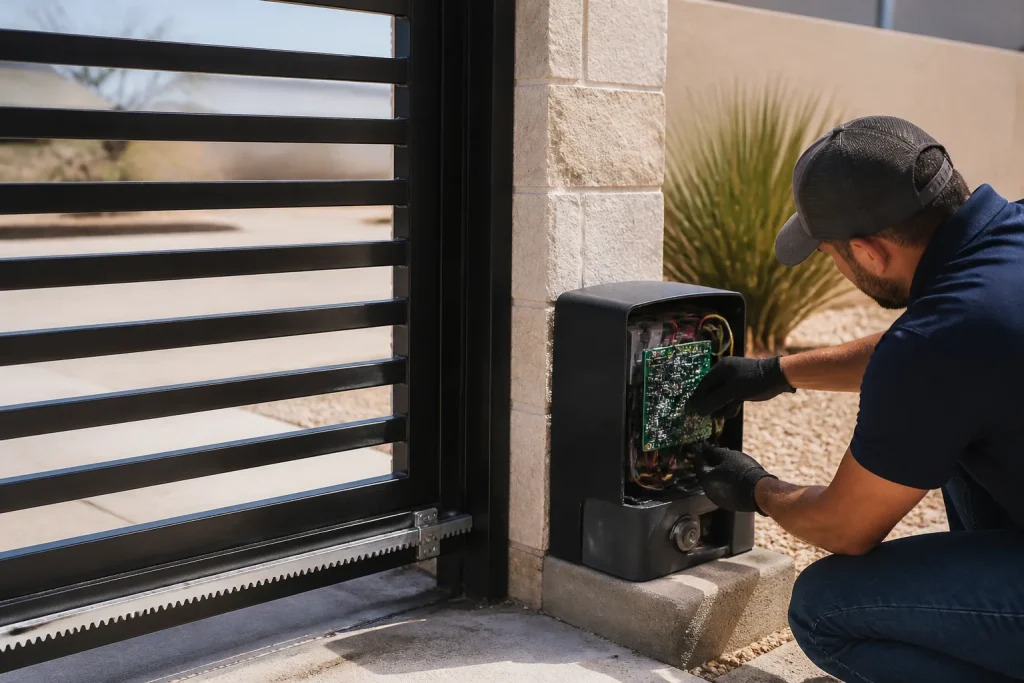
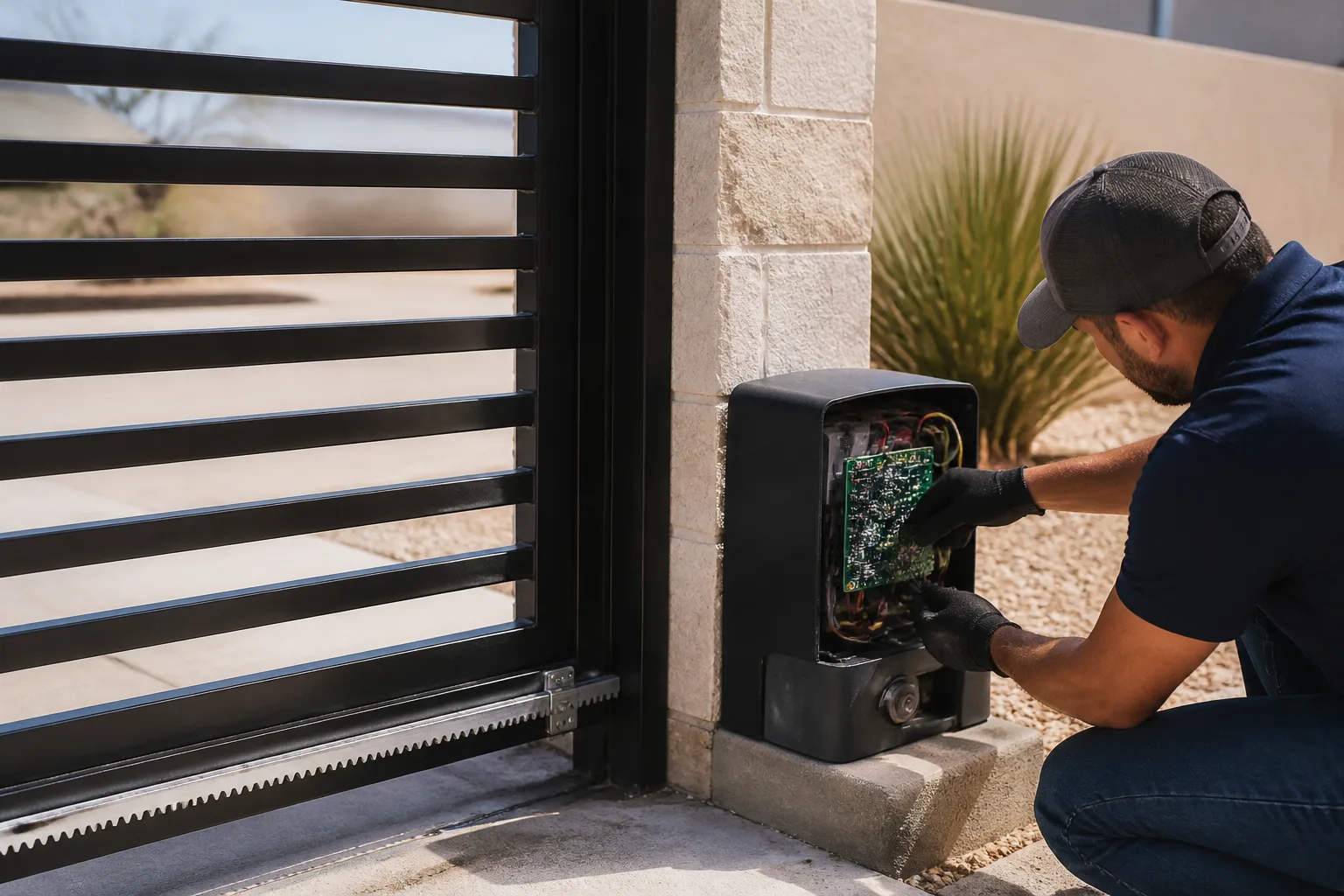
BFT builds a genuinely good operator. The control boards are solid, the motors hold up, and the encoder logic is more precise than a lot of what’s on the market. That precision is also the problem. A BFT arm reads resistance through its motor current, and motor current shifts with temperature. Calibrate a gate at 7 a.m. when it’s 58 degrees out, and by 2 p.m. when the blacktop is pushing 105, the board sees more current on the same resistance and decides something is in the way. The gate reverses halfway. The homeowner thinks the gate is broken. It isn’t. It’s calibrated to the wrong hour.
Spring Valley sits high enough and dry enough that this swing happens almost every day from April through October. We’ve pulled apart operators in Rhodes Ranch and Rhodes Ranch-adjacent neighborhoods where a gate had been “repaired” twice under warranty and the actual cure was rerunning the torque learn at 2 p.m. with the gate warmed up and the sun on it. The fault never came back.
What that looks like in practice:
- Gate reverses mid-travel in the afternoon only – classic cold-calibration symptom.
- Force fault codes that clear on their own – the board is re-learning on the fly, badly.
- Gate runs slow or stalls at one end of travel – mechanical drag, not a board fault, and rerunning calibration won’t fix it.
How BFT’s Self-Learning Torque Calibration Actually Works
BFT operators don’t run on a fixed force setting the way older LiftMaster and FAAC arms sometimes did. The board runs the gate through a full open and close cycle, measures current draw across the whole travel, and builds a profile of what “normal” feels like. Anything outside that profile triggers a reversal. That’s excellent safety engineering. It’s also why the profile has to be built under the conditions the gate will actually face.
- Warm the operator to operating temperature. Run three or four full cycles so the motor and board reach the temperature they’ll see at midday. Skip this and you’re calibrating a motorcycle engine in a walk-in freezer.
- Check mechanical drag first. If a hinge is stiff or a roller is flat, calibration locks in bad drag and calls it normal. Fix the hardware, then calibrate.
- Run the torque learn cycle per the model’s manual. BFT’s procedure varies by board, and using the wrong sequence is common. Half the “BFT won’t hold calibration” complaints we hear are really an incomplete learn.
- Re-test at the other temperature extreme. Close the gate, let it sit in the sun, run it again. If it faults warm, the profile is wrong.
- Verify the safety edges still reverse the gate. A calibrated gate that ignores a photo eye is worse than one that over-triggers.
PHOBOS, IGEA, and VIRGO Don’t Fail the Same Way
This is where a lot of BFT repairs go sideways. The PHOBOS, IGEA, and VIRGO lines use different board logic and different encoder arrangements, and the fault behaviors aren’t interchangeable. A tech who mostly works on Mighty Mule swing arms will read a BFT fault code the way he’d read a Mighty Mule code, and he’ll be wrong.
In our experience in Spring Valley:
- PHOBOS swing operators tend to flag obstruction faults that trace back to calibration temperature or a failing encoder, not the arm itself.
- IGEA sliding operators show more limit-switch and magnet-position issues, especially where a driveway has settled and the track is no longer level.
- VIRGO operators are more likely to throw battery and low-voltage faults first, because the board is more sensitive to supply sag than the swing units.
Diagnosing a BFT by symptom pattern alone is a coin flip. Getting it right means pulling the board’s fault history and knowing which model you’re standing in front of. That’s why we ask for the model number before we roll a truck.
Why BFT Battery Backup Dies Faster in Nevada Than the Spec Sheet Says
BFT’s battery backup units are rated for a service life that assumes moderate, humid conditions. Nevada isn’t moderate and it isn’t humid. Heat is the number one killer of sealed lead-acid batteries, and a battery tucked inside an operator housing on a west-facing Spring Valley wall is sitting in a very hot box for months at a time. In our experience, BFT backup batteries in this climate should be checked annually and replaced closer to a three-year interval than the interval the manufacturer prints. We’ve seen units fail at 18 months in an enclosure that caught full afternoon sun. Move that same enclosure to a shaded north wall and the same battery lasts noticeably longer.
Simple things that stretch battery life:
- Shade the operator housing if you can, or at minimum keep the solar gain off the battery side.
- Test the backup under load, not just with a meter. A battery can read fine at rest and collapse the instant it has to move the gate.
- Check the charger output. A failing trickle charger quietly cooks a battery in the desert.
If you’ve been meaning to get a professional eye on the motor and backup side of things, our Gate Motor & Opener in Spring Valley page covers what a full service visit involves.
BFT Wiring Problems Specific to Exposed-Post HOA Installations
Most Spring Valley HOAs mount BFT operators on exposed metal posts at the gate line, with the low-voltage wire running up the post face or through a stub in the pavement. It looks clean, and it’s also where a lot of intermittent faults start.
The wire jacket on an exposed post takes full UV and full heat cycling. Over a few summers, the insulation goes brittle, small cracks open up, and the control board starts seeing phantom signals. The gate works fine at night and faults in the afternoon, which sends everyone chasing the wrong problem. Add in the wire nuts and splices that some installers leave sitting loose behind the housing, and you’ve got a diagnostic nightmare that takes two minutes to spot if you know where to look.
What we check on an exposed-post install:
- Wire jacket condition at the housing entry and along the post face.
- Connector seating and any corrosion at the board terminals.
- Weatherproofing at the stub and at the housing gasket.
- Ground connection, which matters more than most people realize in dry desert soil.
What a Proper BFT Service Visit Includes (and What Most Techs Skip)
Clearing a fault code is not a repair. A code is a symptom, and if all a tech does is clear it and collect a check, you’re paying for a reset, not a diagnosis. A real BFT service visit in Spring Valley should look like this:
- Pull the fault history before clearing anything, so we can see what’s been recurring.
- Inspect the mechanical first – hinges, rollers, track, post plumb. A sagging gate fools every calibration.
- Test the safety edges and photo eyes – a gate that closes on an obstruction is a liability.
- Run the torque learn at operating temperature and confirm it holds hot.
- Load-test the battery backup, not just the voltage.
- Inspect the wiring and enclosure for UV damage and moisture intrusion.
- Document what was found so the next person isn’t starting from zero.
The steps most outfits skip are 4 and 5, and those are exactly the two that prevent a call-back. If you’d rather have the repair done once, our Gate Repair in Spring Valley page walks through how we handle it.
When to Call a Pro
BFT operators carry enough stored force and enough line voltage to hurt you. If your gate reverses on a person, you see scorching on the board, or the post is shifting out of level, stop cycling it and get someone out. The Gatewood Fence & Gate Spring Valley home page has our contact info and standing offers. Our technicians have up to 25 years of experience, and every job comes with our 90-Day Done Right Promise in writing. We also work on LiftMaster and Mighty Mule operators if your setup uses one of those.
Related Services in Spring Valley
If you’re weighing repair against replacement, take a look at Gate Installation in Spring Valley before you decide. A lot of BFT arms that get “replaced” don’t need to be.
What happens when you call
- 1
A real person answersNo phone trees – you reach a local pro.
- 2
You get an upfront price rangeHonest numbers before anyone is dispatched.
- 3
A background-checked tech heads outLicensed & insured, dispatched right away.
- 4
You approve before work beginsNothing starts until you say go.
The Bottom Line
BFT is a solid brand that gets blamed for problems that come from calibration, wiring, and battery maintenance more often than from the operator itself. The fix is usually understanding the torque learning cycle, calibrating at real operating temperature, and knowing that PHOBOS, IGEA, and VIRGO don’t fail the same way. Do those three things and a Spring Valley BFT gate will run for years. Skip them and you’ll be paying for the same repair every six months.
If you’re in Spring Valley and need help, Gatewood Fence & Gate Spring Valley offers free estimates. Call (888) 300-3906 and we’ll get you scheduled. Prices are quoted and agreed before any work starts, our standing offers include $40 off any repair over $200 and no trip charge inside the county, and a live person answers every call around the clock.
Frequently Asked Questions
It’s almost always calibration temperature. The board was taught the gate’s resistance when it was cool, and afternoon heat raises motor current enough to trip the obstruction logic. Rerunning the torque learn with the operator at full operating temperature fixes it. Call (888) 300-3906 for a free estimate if you’d like us to handle it.
Plan on checking it annually and replacing closer to three years than the manufacturer’s printed interval. Heat degrades sealed lead-acid batteries faster here than the spec sheet assumes, and a shaded enclosure buys you real time. Call (888) 300-3906 and we’ll load-test yours.
Sometimes. If you can read us the fault code and the model, we can usually narrow it to a couple of likely causes before anyone rolls a truck. What we won’t do is guess at a price and change it at the door. Call (888) 300-3906 for a free second opinion on any written estimate.
Yes. BFT is one of the brands we’re certified to service, alongside LiftMaster, FAAC, and Linear. We repair on site rather than hauling the operator off, and every job carries the 90-Day Done Right Promise in writing. Call (888) 300-3906 for a free estimate.
Written by the team at Gatewood Fence & Gate Spring Valley.
Need Gate Repair Help?
Call Gatewood Fence & Gate Spring Valley - licensed & insured, here with fast after-hours help in Spring Valley.
(888) 300-3906